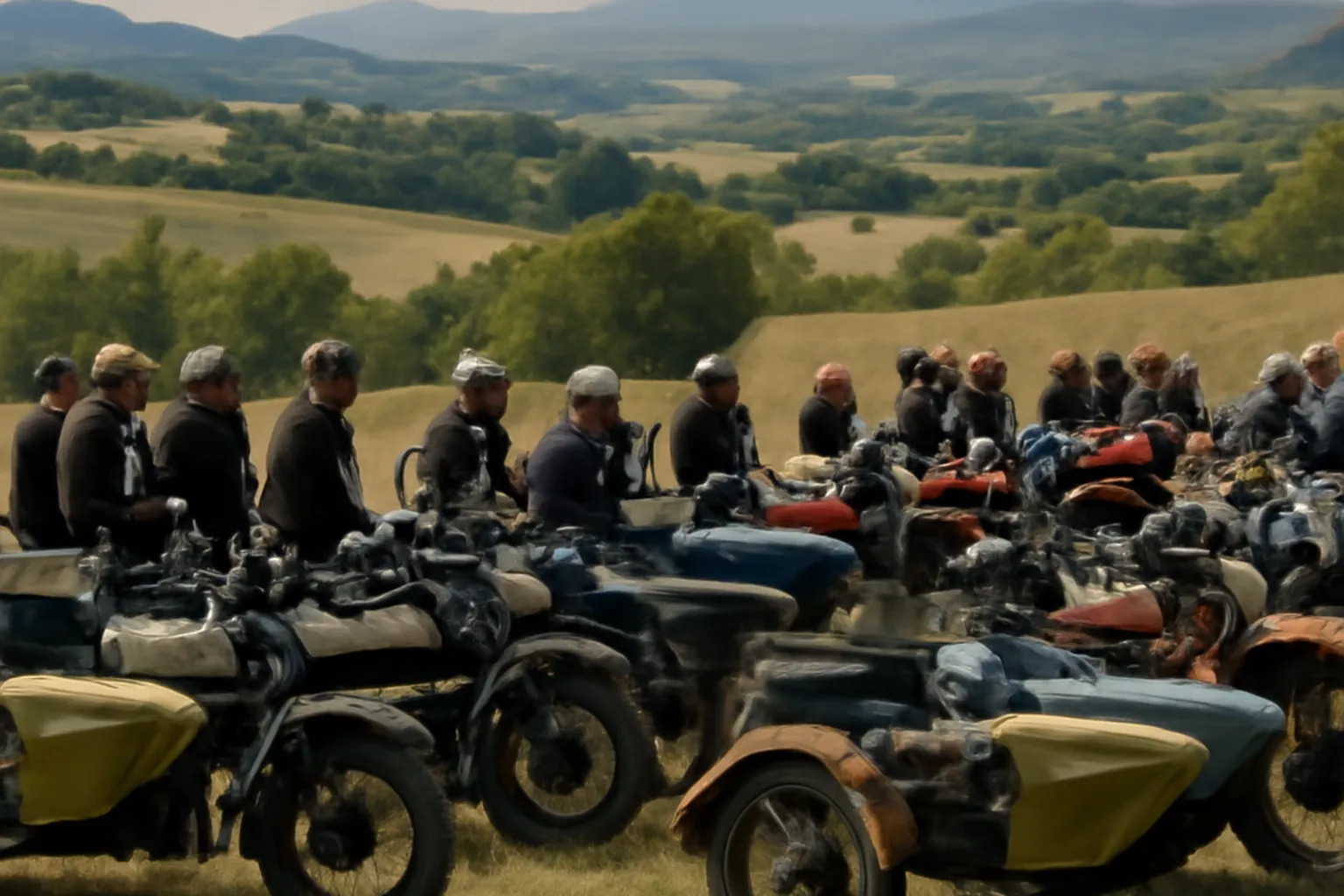
Marie Fontaine has ridden her Ural for six years. Bertrand Couzin is an amateur mechanic and club treasurer. Together they talk about daily life with an Ural.
Interview conducted by Sophie Renaud, Ural-France editorial team, at the Grenoble regional gathering.
Club Ural France organises a regional gathering each spring in a different city. This year, the Rhône-Alpes section is hosting. Around twenty machines are parked outside the chosen restaurant — a mix of immaculate Tourists, Gear Ups loaded as if for a polar expedition and a few older ones, worn smooth by the years.
Marie Fontaine arrives last, her 2020 burgundy Tourist purring gently. Beside her, Bertrand Couzin climbs off his own Ural, a 2018 Gear Up he has heavily personalised. We find a table away from the hubbub.
Marie Fontaine: I’d been riding motorcycles for fifteen years — first a 125 at school, then a Honda CB500, then a Triumph Bonneville. I loved bikes with soul and character. One day, a friend took me as a passenger in his Ural sidecar. First reaction: “This is absurd, it wobbles, it’s noisy.” Then, halfway along a country road, something clicked. The way you see the landscape from the sidecar body. The pace the machine imposes. I asked to drive on the way back. Two months later, I bought a Tourist.
The gender question comes up often. I don’t find it relevant. The Ural accepts any build and any physical strength — it’s not a machine that requires strength, it’s a machine that requires technique. And technique is learned.
Bertrand Couzin: Practically, yes. My background: ten years in the automotive sector before changing fields. Mechanics has always been my passion. The Ural is one of the few modern motorcycles where you can still do everything yourself without specialist tools. No diagnostic computer, no high-pressure fluids, no welded components requiring block replacement. It’s a philosophy of repairability I hold deeply.
My 2018 Gear Up has 43,000 km on the clock. I redid the valves at 30,000 km, changed the wheel bearings at 35,000 km, fitted a custom aluminium sump guard. All in my garage at weekends. I think many people underestimate their capacity to maintain this type of machine.
BC: We’re about forty active members in the region. I’ve been treasurer for three years. The organisation is light: a monthly outing (generally the second Sunday of the month), an AGM in November, a few one-off events. Subscription fees cover communication costs, event insurance and sometimes shared equipment purchases — portable compressor, bearing puller, etc.
What seems most valuable in the club is the informal skills directory. Among our forty members, we have an electrician, a plumber, a welding specialist, a leatherworker who makes custom seat covers. We help each other well beyond motorcycles. It’s a real community in the deep sense.
MF: The Franco-Italian Alpine crossing last year. Fifteen days, 2,400 km, alone with my Tourist and my cat in the sidecar — yes, I take my cat. People stop all the time to look. It’s become a running joke in the community: “Marie and her cat on the Ural.”
That journey was transformative. The Alps by sidecar is a unique experience. The passes at 40 km/h, the Italian villages where nobody knows what an Ural is but everyone wants a photo, bivouacs in alpine meadows. If I close my eyes, I can still hear the engine purring at 2,800 rpm on the Col de l’Izoard.
BC: Strongly. When we go to the Ural Treffen in Germany — the big European gathering, 200-300 machines assembled — you understand the extent of this family. Americans, Australians, Japanese, Russians who come specially… Everyone speaks the same language, that of shared mechanics and laughing at breakdowns.
It’s one of the rare communities where I’ve never felt competition or judgement. It doesn’t matter what state your machine is in, whether you arrived on a rusty 1998 Tourist or a shiny 2026 Gear Up. What matters is being there.
MF: And the concrete solidarity on the road. I had a sidecar tyre puncture 80 km from home. An Ural owner I’d never met spent an hour with me helping change the wheel. You can’t fabricate that.
MF: Come to a club outing. No need for an Ural, no need for mechanical knowledge. Come to see, touch, talk. The machine is overwhelming once you’ve really approached it close up.
BC: And don’t fear the maintenance. If I’d waited until I “knew” mechanics before buying my Ural, I’d never have had one. You learn on the job, with the community, and that’s what’s beautiful.
Key takeaway: Beyond the annual gatherings, what makes Club Ural France valuable is the informal skills directory among members — an electrician, a plumber, a welder, a leatherworker — who help each other with repairs well beyond motorcycles. Membership isn’t reserved for owners: prospective buyers are welcome at outings before they buy.
Club Ural France — official site: contact the official Ural France importer for details. Rhône-Alpes section: information available on dedicated Facebook groups.
To plan your own Ural journey, see our sidecar road trips in France and our Ural road trips guide.
Frequently Asked Questions
Club Ural France is open to new members (modest annual subscription). The official site lists regional section contacts. Most sections organise monthly outings open to non-members for a first visit.
This is one of the club's most important functions. More experienced members often accompany new owners for first services, help diagnose breakdowns and share specialist contacts. This voluntary mutual assistance is at the heart of Ural culture.
Yes, Club Ural France organises several annual events including the French Ural Meeting (generally in June in a different region each year), monthly outings per section and participation in European gatherings (German Ural Treffen, Belgian Ural Fest, etc.).
Technically the club welcomes Ural owners, but many sympathisers attend events and participate in forums before buying their machine. It's often in this context that future buyers meet owners and get their first test rides.
Club Ural France brings together approximately 300-400 active members across France, organised into regional sections. On online platforms (Facebook, specialist forums), the French-speaking Ural community is larger with several thousand people involved to varying degrees.