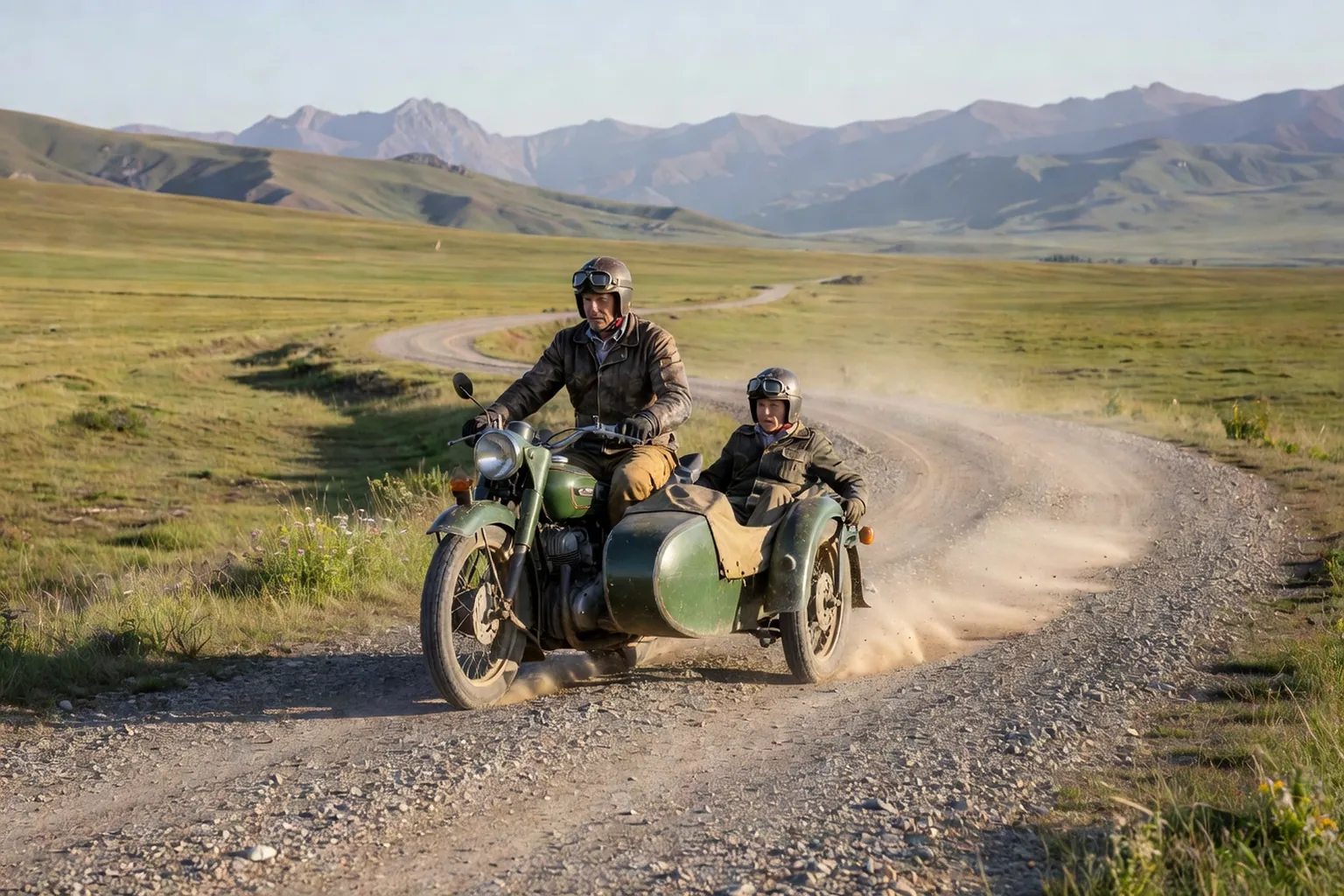
Riding an Ural sidecar is unlike anything you know. The vehicle pulls right, brakes asymmetrically and requires a complete re-education. This guide gives you the technical keys to master your machine.
Why the Sidecar Changes Everything
Riding an Ural sidecar isn’t difficult. It’s different. This nuance is fundamental: the greatest obstacle isn’t the technique itself, but the necessity to unlearn what you think you know about riding.
An experienced motorcyclist must unlearn counter-steering. A car driver must understand why their vehicle pulls right. Both must accept that braking is managed asymmetrically. This re-learning process generally takes two to four hours of actual riding — which is quite short in reality.
What makes sidecar riding so distinctive is its intermediate status between two worlds. It’s not a motorcycle (three wheels, no lateral imbalance), not a car (steering wheel replaced by handlebars, two wheels in line for the motorcycle), not a trike (the sidecar is asymmetric). It’s a sui generis vehicle that demands its own reflexes.
Key takeaway: Sidecar riding isn’t harder than solo motorcycling — it’s different, and the re-learning period is short (2-4 hours). The single most important mental shift: forget counter-steering entirely and accept the asymmetric pull under acceleration and braking as the machine’s normal character, not a fault.
The Physics of the Sidecar: Understanding to Ride Better
Imagine an Ural in a straight line. The rear wheel and the sidecar wheel are aligned perpendicularly to the direction of travel. The motorcycle’s front wheel is also in line. Everything is fine.
Now brake moderately. The front wheel slows first. If you brake too hard, it tends to pull left (opposite side to the sidecar) because the sidecar continues on its momentum. Result: the whole thing pitches nose-left. Counter-intuitive, but logical once understood.
Under acceleration, the opposite phenomenon: the sidecar is pushed forward by the motorcycle’s inertia, and the whole thing pulls right (toward the sidecar). You’ll need to apply a slight counter-pressure on the handlebars to the left to maintain a straight line.
These asymmetric forces are constant. You’ll learn to anticipate and compensate for them instinctively. After a few hours, it’s no longer a constraint — it’s the character of the machine.
The Licence to Ride an Ural Sidecar
Licence requirements vary by country. In most European countries, a standard car driving licence (category B) is sufficient for a sidecar combination above certain weight thresholds. Check your country’s specific regulations and always verify the vehicle registration document.
In France specifically, the category B (car) licence is sufficient for the Ural with sidecar (total weight 340-380 kg depending on model). No motorcycle licence required. This is good news for car drivers who want to join the Ural community without taking the motorcycle test.
For insurance, companies generally offer “sidecar” policies at reasonable rates. The statistical risk being lower than that of a solo motorcycle, premiums are often comparable to a car of similar engine size.
Cornering Technique: Right vs Left
This is the most disorienting point for beginners. A right turn and a left turn on a sidecar are completely different experiences.
Left turn (toward the motorcycle side):
Turning left, inertia pushes the sidecar toward the outside of the turn (rightward). If you turn too fast, the sidecar wheel can lift. This is the “sidecar lifting” phenomenon. In extreme cases (tight corner at high speed), the sidecar can tip over. Technique: slow down before the corner, maintain a moderate speed, look well ahead.
Right turn (toward the sidecar):
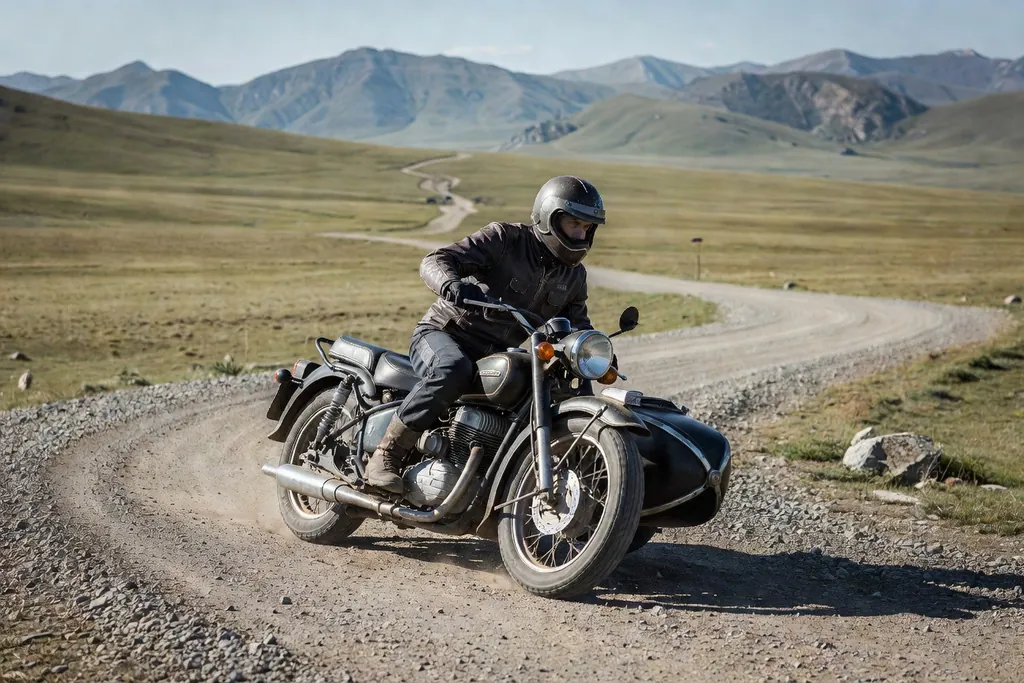
Turning right, the motorcycle’s inertia pushes toward the outside left. The handlebars resist. To turn right, you must push firmly on the right side of the handlebars. On Urals with the sidecar on the right (standard configuration), right turns require more effort than left turns.
Your First Miles: The Recommended Protocol
Never hit the road without practising in a car park or empty industrial area. Here is the recommended protocol for the first hours:
Step 1 — Familiarisation (30 min): Move forward in a straight line, brake progressively. Repeat 10-15 times. Notice how the vehicle pulls slightly right under acceleration, left under braking.
Step 2 — Wide corners (30 min): Describe large circles on the car park, first left, then right. Stay at 20-30 km/h maximum. Note the difference in feel.
Step 3 — Emergency braking (20 min): Accelerate to 30-40 km/h and brake firmly. The goal is to feel how the vehicle reacts and build confidence in your ability to stop.
Step 4 — First roads (1 h): Choose quiet roads, avoid main roads. Maximum speed 60 km/h.
| Step | Duration | Exercise | Speed |
|---|---|---|---|
| 1. Familiarisation | 30 min | Straight-line riding, progressive braking, 10-15 repeats | Low speed |
| 2. Wide corners | 30 min | Large circles, left then right | 20-30 km/h max |
| 3. Emergency braking | 20 min | Accelerate then brake firmly | 30-40 km/h |
| 4. First roads | 1 h | Quiet roads, avoid main roads | 60 km/h max |
Most riders are road-ready after 2-3 hours of guided practice. After a full day, reflexes begin to settle. Allow two to three weeks of regular riding to feel truly comfortable in all situations.
Riding in 2WD Mode (Gear Up Only)
The Gear Up has a control lever allowing engagement of the sidecar wheel drive. This function should only be engaged at low speed (below 40 km/h) on difficult terrain.
In 2WD mode, the motorcycle becomes noticeably harder to steer on road: both driven wheels create significant steering constraints. Only use 2WD when necessary: muddy climb, slippery descent, deep sand.
The transition between 1WD and 2WD should be made with the machine stopped or at very low speed. Forcing engagement while riding risks damaging the transfer mechanism.
Load Effects on Handling
Sidecar behaviour changes significantly depending on load. An empty sidecar behaves differently from one with an 80 kg passenger or one loaded with camping equipment.
General rule: the more loaded the sidecar, the more it resists left turns (reduced tendency to lift) and the longer braking distances become. The lighter the sidecar, the more delicate left turns become.
Always distribute load evenly. Don’t place all weight in the nose of the sidecar or in its rear section. Use the provided fixings to secure luggage.
Long-Distance Preparation
For trips over 5 days, proper preparation is essential. Our complete maintenance guide covers all the checks to make before departure. Key points:
- Complete preventive service before departure
- Tyres in good condition — check wear and pressure before each leg
- Essential spares: spark plugs, head gaskets, brake and throttle cables
- Emergency contacts: Ural dealers in each country, local club contacts
- Reserve budget: allow €200-400 for unexpected mechanical issues
Frequently Asked Questions
Licence requirements vary by country. In most EU countries including France, a standard car driving licence (category B) is sufficient for a sidecar combination over 400 kg total weight. In the UK, a full car licence covers sidecar combinations. Always check your local regulations and the vehicle registration document to confirm.
Sidecar riding is technically different from motorcycle or car driving, but it is learned quickly. The first kilometres are disorienting (no counter-steering, asymmetric cornering) but most riders find their feet within 1-2 hours. A half-day of practice on a car park is strongly recommended before hitting the road.
Yes, motorways are possible but the comfortable cruising speed of an Ural is 80-100 km/h. The homologated top speed is 105 km/h. At 110-130 km/h, handling degrades and fuel consumption increases significantly. For long motorway journeys, plan frequent breaks and prefer national roads.
Braking on an Ural sidecar is asymmetric. The front brake (right lever) brakes the motorcycle's front wheel. The rear brake (right foot pedal) brakes the motorcycle's rear wheel AND the sidecar wheel via a mechanical link. For emergency stops, use both brakes progressively. Current Ural models do not have ABS.
In rain, the Ural motorcycle is stable thanks to its three contact points. It doesn't slide like a solo motorcycle. However, the motorcycle's front wheel can aquaplane if the road surface is very degraded. Standard tyres are adequate but can be upgraded for better wet weather traction. Slow down progressively, avoid sharp braking.