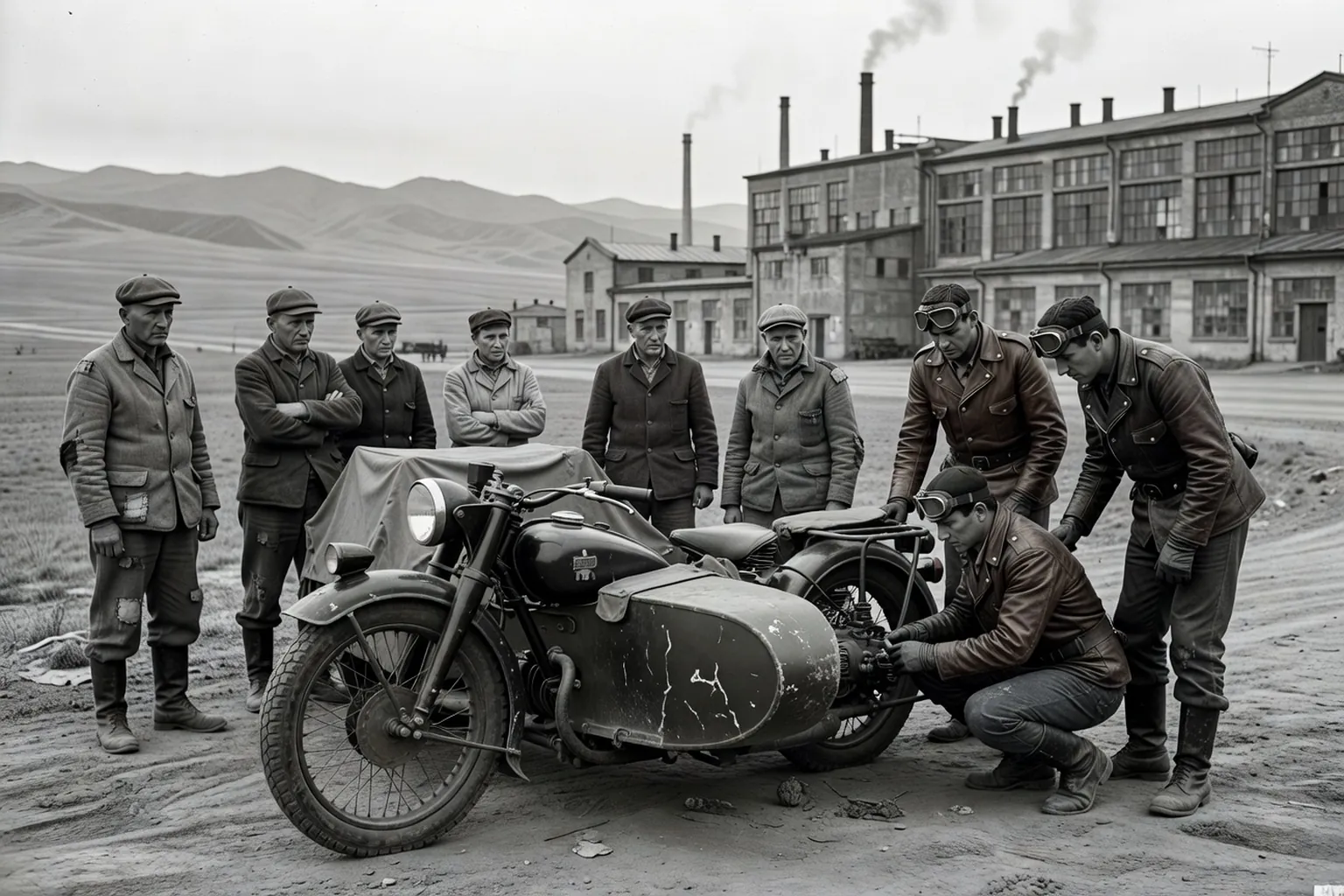
Born from the urgency of World War II, the Ural motorcycle became a symbol of freedom and adventure. A journey through 80 years of unique history, from the Siberian factory in Irbit to roads around the world.
Soviet Origins: A BMW Confiscated by History
In June 1941, Nazi Germany launched Operation Barbarossa. As the Panzers swept across the Russian plains, Stalin made an industrial decision that would change the history of motorcycles worldwide: he ordered the emergency relocation of the Moscow IMZ factory (Irbit Motorcycle Works) eastward into the Ural Mountains, more than 1,500 kilometres from the front line.
The motorcycle that would emerge from this factory was not born from nothing. In 1940, the USSR had acquired — legally or otherwise depending on the source — the plans of the BMW R71, a sidecar motorcycle that the German army itself used. History’s irony is that Soviet soldiers repelled the Germans aboard copies of their own machines.
The first Ural M-72, assembled in January 1942 in Irbit, was visually identical to the BMW R71: 746cc flat-twin engine, shaft drive, right-side sidecar. Soviet engineers had copied the design verbatim, lacking time to innovate.
Key takeaway: The Ural motorcycle wasn’t designed — it was inherited from the BMW R71 during the 1941 emergency relocation to Irbit. Its DNA (flat-twin engine, shaft drive, sidecar) has barely changed in 80 years, which is exactly why parts availability and repairability remain unmatched among modern motorcycles.
| Year | Milestone |
|---|---|
| 1941 | IMZ factory relocated from Moscow to Irbit during Operation Barbarossa |
| 1942 | First Ural M-72 assembled in January, based on BMW R71 plans |
| 1953 | M-52 model introduced with an improved sidecar |
| 1960s | Ural Planeta and Ural M-66 popularise the brand among Soviet buyers |
| 1970s-1980s | Production peaks at over 130,000 units per year |
| 1990 | Irbit factory still producing 100,000 motorcycles per year |
| 1991 | Collapse of the USSR ends state subsidies and institutional orders |
| 1999 | Annual production falls to under 6,000 units |
| 2004 | Front disc brakes introduced (rear follows later) |
| 2014 | Electronic fuel injection (EFI) added on export models |
| 2026 | Approximately 30,000-40,000 Urals in circulation worldwide; production held at 500-800 units/year |
The Irbit Factory: A City Devoted to Motorcycles
Irbit is a small Ural town whose history is intimately linked to motorcycles. Before the war, it was known for its annual trade fair — one of the most important in Russia. In 1941, it became the heart of Soviet wartime motorcycle production.
The IMZ factory would employ up to 6,000 people at its peak. During the 1970s and 1980s, Irbit produced over 130,000 motorcycles per year. An entire city lived to the rhythm of production cycles, shift changes and deliveries. Local engineers developed their own technical culture, progressively adapting the original design to Soviet realities.
The accumulated expertise was considerable: field repairs in extreme conditions, adaptation to poor-quality fuels, operation at -40°C. These qualities of rugged robustness would later become the most convincing sales arguments in Western markets.
The Soviet Era: The People’s Motorcycle
After the war, the M-72 was not demobilised. It became a civilian motorcycle of primary importance in 1950s USSR. Soviet kolkhozes — collective farms — received them for their surveillance teams. Police, firefighters and forest units were equipped with them.
Production evolved slowly. In 1953, the M-52 model introduced an improved sidecar. In the 1960s, the Ural Planeta and Ural M-66 popularised the brand among the Soviet public. These machines weren’t fast (95 km/h top speed) or comfortable in the Western sense, but they were robust, repairable with basic tools and available in state shops.
For millions of Soviet families, owning an Ural represented a form of freedom of movement. You could load market supplies, take children to school, go mushroom picking at weekends. The sidecar motorcycle was deeply embedded in Russian popular culture.
The 1990s Crisis and Survival
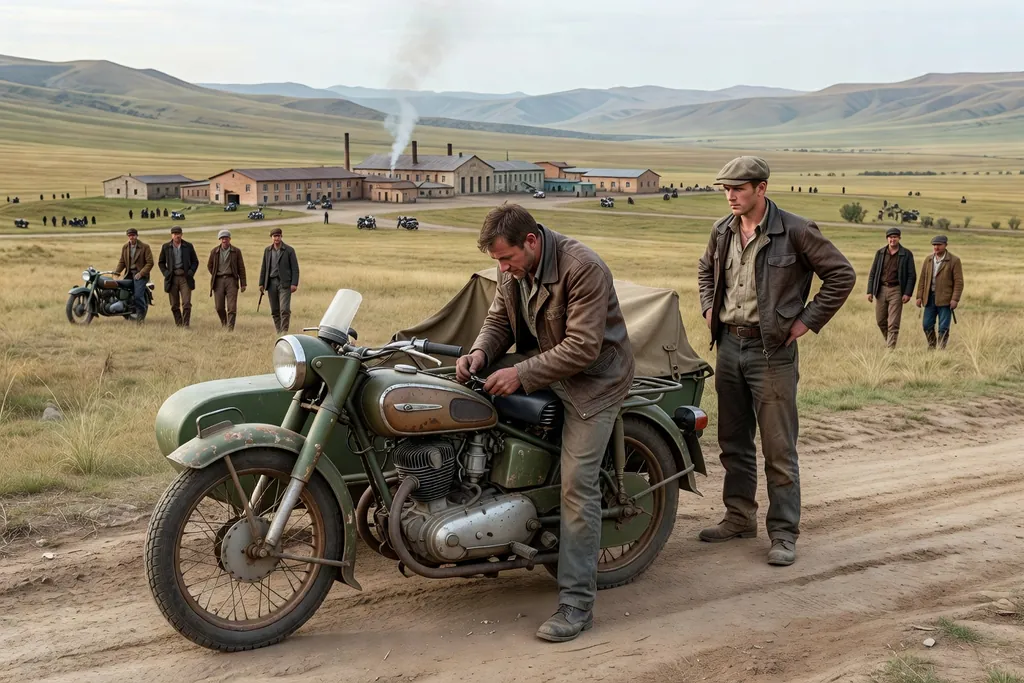
The collapse of the USSR in 1991 hit IMZ hard. Overnight, state subsidies disappeared, institutional orders evaporated and civilian demand collapsed in the face of an influx of cheap Western cars. The Irbit factory, which still produced 100,000 motorcycles per year in 1990, fell to under 6,000 in 1999.
This decade of survival forged a crucial lesson: the Ural motorcycle had to reinvent itself to conquer Western markets. The United States and Western Europe began importing Urals in the 1990s, initially as retro curiosities, then as authentic adventure machines.
The decision was made to deliberately limit production, improve quality at the expense of volume and position Ural as a premium niche motorcycle with an artisanal character. This was a radical pivot for a factory accustomed to mass production.
21st Century Modernisation
From the 2000s, and especially since 2010, IMZ-Ural has undertaken a deep technical transformation. For the current models, the changes are significant:
- Switch to electronic fuel injection (EFI) in 2014 on export models
- Front disc brakes (from 2004) then rear
- Updated wheel bearings
- Revised gauges and instruments
- Comfortable seats and improved suspension
- Compliance with Euro 5 emission standards
The 2WD all-wheel drive — which allows engaging the sidecar wheel for obstacle crossing — has been refined and has become a primary commercial argument. This system, unique in the world, justifies the purchase for many adventure enthusiasts.
Ural in the World: A Global Community
In 2026, approximately 30,000 to 40,000 Ural motorcycles are in circulation worldwide. The United States remains the primary market, followed by Germany, France and Australia. The international community of “Uralists” is tight-knit, passionate and very active online.
Clubs exist in around twenty countries. In France, Club Ural France organises annual gatherings that attract owners from across Europe. These meetings are as much celebrations of vintage mechanics as of a lifestyle: embraced slowness, breakdowns managed with philosophy, shared adventures.
The brand carefully cultivates this myth. Each motorcycle leaves the factory with a serial number hand-engraved on the engine crankcase. Advertisements feature wild landscapes, tents pitched by glacial rivers, deserted roads stretching to the horizon. Ural doesn’t just sell a motorcycle: it sells a philosophy.
A Living Mechanical Heritage
The longevity of the Ural brand — more than 80 years of continuous production in the same factory — is itself a remarkable phenomenon in the motorcycle industry. No other manufacturer has maintained such geographical and mechanical continuity.
Shaft drive, flat-twin engine, large wheels interchangeable between motorcycle and sidecar: some components have spanned decades with minor modifications. This mechanical consistency guarantees long-term parts availability, which is crucial for owners who maintain their own machines.
Ural is one of the rare motorcycles where you can still learn the mechanics from a 1970s service manual and repair with rudimentary tools. In a world of increasingly complex electronic machines, this technical accessibility has become a sought-after virtue.
For riders who want to learn how to ride this unique machine, the technique is as distinctive as the history behind it.
Frequently Asked Questions
The Ural brand was founded in 1941 in Irbit, in the Russian Urals. The IMZ factory (Irbit Motorcycle Works) was urgently relocated from Moscow to keep it out of range of the German advance. The first motorcycles produced were copies of the BMW R71 plans.
Originally, Ural motorcycles were designed for the Soviet army, which needed three-wheeled vehicles for patrols and soldier transport. This configuration continued after the war for the civilian market, making the sidecar the absolute signature of the brand.
Ural motorcycles are still manufactured in Irbit, in the Russian Urals (Sverdlovsk region). While the brand is now owned by American and European investors, assembly remains artisanal in Russia, at a pace of 500 to 800 units per year.
More than 3.2 million Ural motorcycles have been produced since 1941. Production peaked in the 1970s-1980s with over 130,000 units per year. Today, production is deliberately limited to 500-800 units per year to maintain the artisanal character.
Modern Urals (since around 2015) are significantly more reliable than older generations. Electronic fuel injection, disc brakes and improved manufacturing quality have greatly enhanced durability. Regular maintenance every 5,000 km remains essential, but serious breakdowns have become rare.