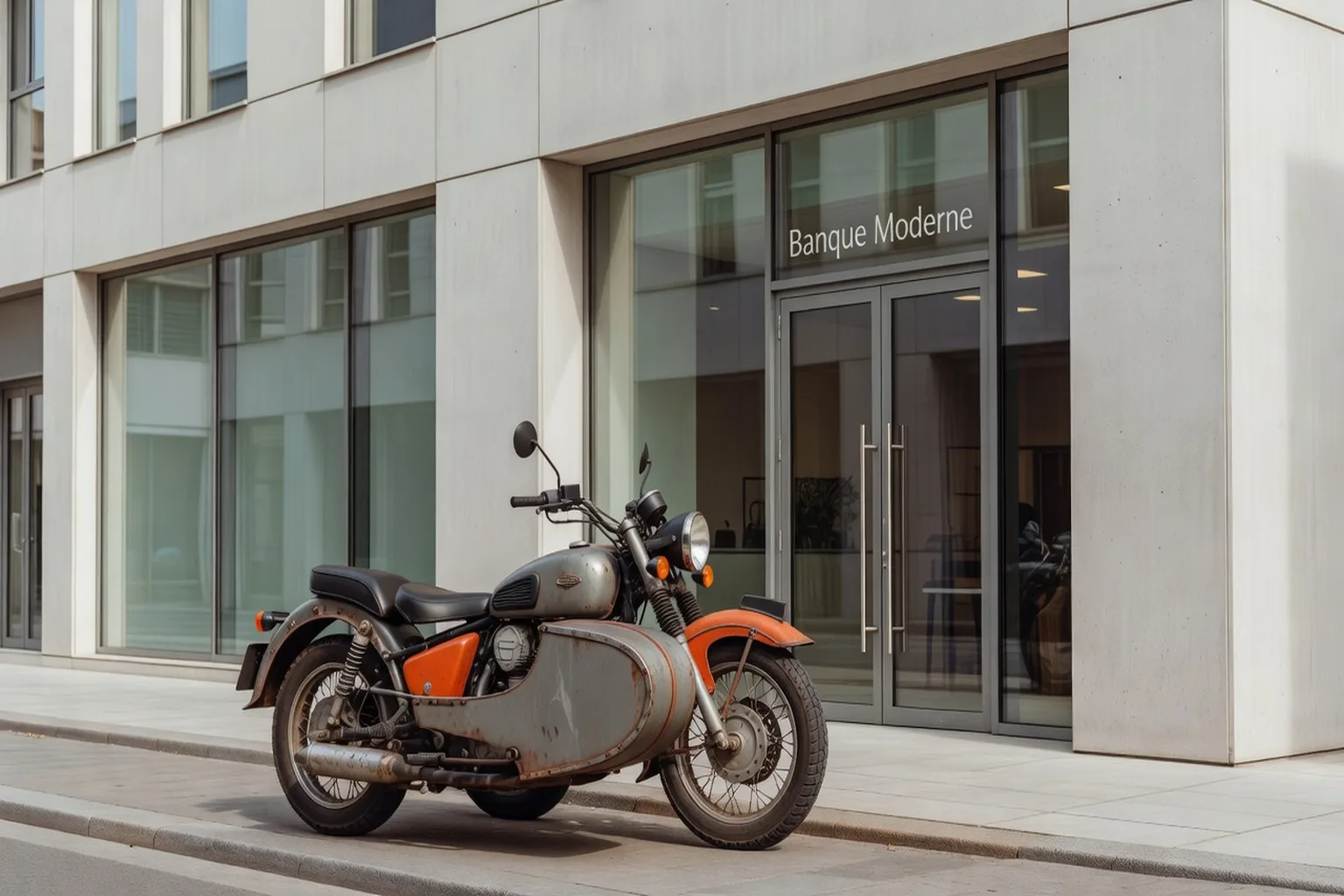
Financing a Ural raises questions a mainstream motorcycle loan doesn't: limited resale data, niche insurer requirements, and residual value that doesn't follow a standard Argus curve. This guide covers dealer credit, personal loans, and how to structure a loan that fits the Ural's ownership profile.
Financing a Niche Vehicle Is Different from Financing a Mainstream Bike
A Ural doesn’t finance quite like a mainstream Japanese or European motorcycle, and the reason isn’t mechanical risk — it’s data. French lenders lean heavily on established resale indices to underwrite motorcycle loans, and those indices are built on sales volume that a low-volume, niche vehicle like the Ural simply doesn’t generate. That single fact shapes almost every practical financing decision covered here: which loan type fits best, how much to put down, and what pitfalls to avoid. This guide focuses exclusively on purchase financing mechanisms; for the ongoing costs of owning a Ural once it’s financed, see our total cost of ownership guide, and for vehicle selection itself, our used-buying guide.
Key takeaway: The single biggest structural difference in financing a Ural versus a mainstream motorcycle isn’t the interest rate — it’s that lenders can’t lean on a reliable resale index, which pushes most financing decisions toward a larger down payment and a shorter term than you might default to otherwise.
Dealer-Affiliated Credit
Buying a new Ural through an official French dealer typically comes with access to dealer-affiliated financing, arranged through the dealer’s banking or finance partner at the point of sale.
Advantages: convenience (the paperwork is handled alongside the purchase), and the finance partner is generally already familiar with pricing this specific vehicle, which can smooth underwriting compared to approaching a lender cold with an unfamiliar niche product.
What to check: dealer-affiliated rates are competitive on mainstream vehicles because dealers negotiate volume terms with their finance partners, but on a lower-volume product like the Ural, it’s worth explicitly comparing the dealer rate against a personal loan quote rather than assuming the dealer offer is automatically the best available — the volume leverage that makes dealer financing attractive on mainstream bikes is weaker here.
Personal Unsecured Loans
A personal loan (crédit personnel non affecté, or an affected personal loan tied to the vehicle) from your own bank or an online lender is the most flexible option, particularly relevant for a private-party used purchase where dealer financing isn’t available at all.
Why flexibility matters here specifically: a private-party seller wants payment on their timeline, not synced to a dealer’s financing paperwork, and a personal loan (already approved, funds in hand) lets you move at the pace the transaction requires rather than waiting on financing tied to a specific dealer transaction.
Underwriting consideration: without a dealer partner vouching for the vehicle type, you may need to more explicitly demonstrate the vehicle’s value to your lender — a written valuation, comparable listings, or a mechanical inspection report can help support the file, especially for a used purchase where the lender has no manufacturer relationship to lean on.
New vs Used: How Underwriting Differs
| Factor | New Ural | Used Ural |
|---|---|---|
| Resale index available | Limited but manufacturer MSRP anchors initial value | Thin — few comparable sales to reference |
| Typical lender response | Standard motorcycle loan terms, dealer-affiliated options available | Larger down payment or shorter term often required |
| Documentation that helps | Dealer invoice, manufacturer warranty | Mechanical inspection, maintenance history, comparable listings |
| LOA availability | Occasionally offered, terms vary | Rarely offered for used niche vehicles |
The underlying issue for used purchases is straightforward: a lender sizing a loan against collateral value needs some way to estimate what the vehicle would be worth if repossessed and resold, and a niche vehicle with few comparable transactions makes that estimate inherently less reliable — which lenders price for through structure (down payment, term) rather than necessarily through rate alone.
Is LOA (Lease-to-Own) Worth Considering?
Lease-to-own financing depends on the leasing company accurately pricing residual value at lease-end — essentially betting on what the vehicle will be worth in three or four years. For high-volume motorcycles with deep resale data, this works well and often produces attractive monthly terms. For a Ural, the same thin resale data that complicates a used-purchase loan makes LOA residual-value pricing considerably harder for the leasing company to get right.
In practice, this means LOA is rarely offered for the Ural at all, and where it is available, terms tend to be less competitive than for mainstream vehicles, since the leasing company builds in a margin of safety against the residual-value uncertainty. For most Ural buyers, a personal or dealer-affiliated loan structured with a healthy down payment is the more practical and often more cost-effective path.
Down Payment and Loan Duration Strategy
Given the Ural’s residual value curve — generally slower to establish a predictable resale pattern than a mainstream motorcycle, though the platform holds genuine collector and enthusiast interest that supports long-term value in its own way — two adjustments to standard motorcycle financing practice are worth making:
- Down payment: aim higher than you might on a mainstream bike, roughly 30-40% rather than a minimal deposit. This reduces the risk of being underwater on the loan (owing more than the bike would currently sell for) if your circumstances change and you need to sell before the loan term ends.
- Loan duration: a shorter term, even at a marginally higher monthly payment, reduces the window during which resale value and loan balance could diverge unfavourably, compared to stretching the loan over the longest term a lender will offer.
Key takeaway: Treat the Ural’s financing structure more like financing a collector vehicle than a mainstream commuter motorcycle — a bigger down payment and a shorter term aren’t overly cautious here, they’re the structure that actually matches how this specific market behaves.
Insurance and Your Financing File
French lenders generally require proof of at least third-party liability coverage before releasing loan funds, and building your insurance quote into the financing conversation early — rather than treating it as a final step after loan approval — avoids a common bottleneck. A few practical points:
- Get an insurance quote before finalizing your loan application, not after, since financing timelines can move faster than some insurers can process a niche-vehicle policy.
- Some insurers price the Ural differently from a mainstream motorcycle of similar displacement, given its distinct risk profile (lower average mileage in some cases, but also specialist repair costs) — shop more than one quote specifically for this vehicle rather than assuming a generic motorcycle insurance comparison tool captures it accurately.
- A notably high insurance quote can itself be a data point your lender factors into the overall file, so resolving insurance early keeps the whole financing process on a predictable timeline.
For context on which model and configuration you’re financing, our Ural models guide is worth reviewing alongside your budget before finalizing a loan amount.
Common Financing Pitfalls to Avoid
- Over-financing relative to resale reality: borrowing as if the Ural will hold value and resell as predictably as a mainstream motorcycle, then being caught out by a slower, thinner resale market if plans change.
- Assuming dealer financing is automatically cheapest: worth an explicit comparison given the weaker volume leverage dealers have on this specific product compared to mainstream vehicles.
- Treating LOA as a default option: it’s rarely competitive for this vehicle category and shouldn’t be assumed available without checking first.
- Leaving insurance until after loan approval: a late insurance quote can stall an otherwise-approved file at the finish line.
What Lenders Actually Ask For on a Ural File
Beyond the standard proof-of-income and identity documentation any French lender requires, a Ural-specific file tends to move faster when you proactively supply a few extra pieces of evidence the underwriter would otherwise have to chase down themselves.
For a new purchase, the manufacturer invoice and warranty documentation from an official dealer generally satisfy the lender’s collateral question without extra work on your part — this is one of the genuine advantages of buying new through the official network rather than a grey-market import. For a used purchase, the file benefits from a written mechanical inspection report (even a modest one from an independent garage), photographs documenting the vehicle’s condition, and — where available — a maintenance history showing the machine has been kept in running order rather than left to deteriorate.
None of this is unique to the Ural in principle; the difference is that a lender underwriting a mainstream motorcycle can often skip straight to a resale-index lookup, while a Ural file benefits more from this supporting documentation precisely because that shortcut isn’t reliably available. Buyers who assemble this paperwork before applying, rather than scrambling for it mid-process, generally see faster approval turnaround.
Choosing a Financing Path: A Decision Grid
| Your profile | Recommended approach |
|---|---|
| Buying new through an official dealer, moderate down payment available | Compare dealer-affiliated credit against a personal loan quote before signing |
| Buying used, private-party transaction | Personal loan pre-approved before negotiating price, supported by an independent mechanical inspection |
| Limited down payment available | Consider delaying purchase to build a larger deposit rather than over-financing a niche vehicle |
| Planning short-term ownership (under 2-3 years) | Favour cash purchase or minimal financing over any loan structure, given resale-timing risk |
Regional Variation in Financing Availability
Access to Ural-specific financing knowledge varies across France depending on dealer density. Buyers near an official dealer benefit from a finance partner already familiar with pricing this vehicle; buyers further from a dealer network may find their local bank branch has never financed this specific vehicle before and needs more supporting documentation to underwrite the file confidently. Budget extra time in the financing process for explaining the vehicle to a lender who may not have encountered it, rather than assuming approval will move as fast as it would for a mainstream motorcycle purchase anywhere in the country.
Key takeaway: Distance from an official Ural dealer doesn’t just affect service convenience after the purchase — it can meaningfully affect how quickly your financing file gets approved, since local lender familiarity with the vehicle varies more than it does for mainstream brands with dealers in every region.
Financing a Ural works, and plenty of French buyers do it successfully — the key is structuring the loan around the platform’s actual resale profile rather than defaulting to assumptions that apply to a mainstream motorcycle. For the ongoing costs once financing is in place, our total cost of ownership guide is the natural next read.
Frequently Asked Questions
Dealer-affiliated credit is often the more convenient path for a new Ural, since it's arranged at the point of sale and the dealer's finance partner is generally comfortable underwriting the specific vehicle. A personal bank loan can offer more negotiating flexibility on rate if you have an existing strong relationship with your bank, but you'll need to make the case for a niche vehicle yourself rather than relying on a dealer partner who already understands the product.
French lenders typically size a used-vehicle loan partly against an established resale index (Argus or equivalent), which exists for high-volume mainstream motorcycles but is thin or unreliable for a low-volume, niche vehicle like the Ural. Lenders may respond by requiring a larger down payment, a shorter loan term, or a somewhat higher rate to offset the harder-to-verify collateral value — not because the vehicle is inherently riskier mechanically, but because it's harder for an underwriter to price.
A larger down payment than you might put on a mainstream motorcycle is generally the more prudent approach, precisely because of the thin resale market — putting down 30-40% rather than a minimal amount reduces the risk of being financially underwater on the loan if you need to sell before the term ends, since a niche vehicle can take longer to sell at full value than a mainstream one.
Generally not, and this is one of the clearer points in Ural financing: LOA pricing depends heavily on the leasing company's ability to estimate residual value accurately at lease-end, which is difficult for a low-volume, niche vehicle without robust resale data. Where LOA is offered at all for a Ural, terms tend to be less favourable than a comparable personal loan, and availability itself is inconsistent compared to mainstream motorcycle leasing.
Yes, indirectly. Lenders in France generally require proof of at least third-party liability insurance (assurance au tiers) in place before releasing funds or finalizing a loan, and some lenders factor the insurance quote itself into their overall risk assessment of the file — a notably high quote for a niche vehicle can be a signal the lender weighs alongside the vehicle's financing risk. Securing an insurance quote early in the financing process, not after loan approval, avoids delays at the final stage.