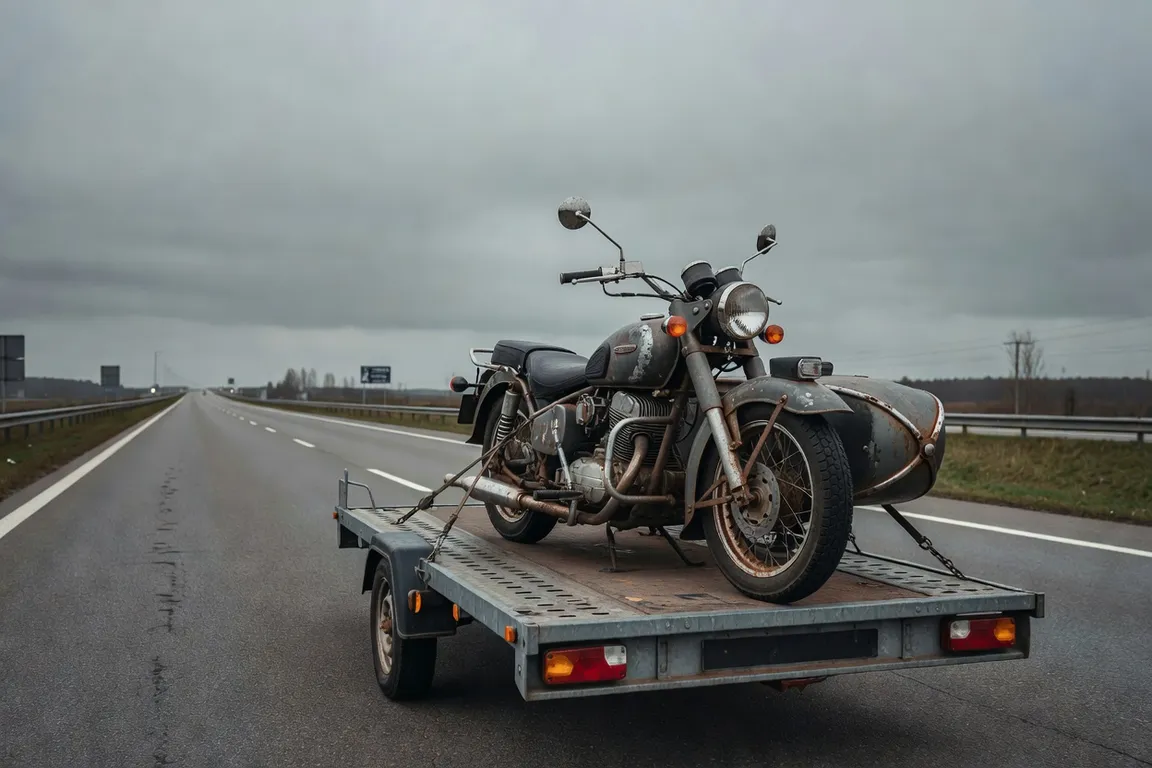
Whether you're bringing home a newly bought Ural from across the country or trying to import one from Russia or Eastern Europe, long-distance transport raises technical, administrative and financial questions this guide answers in detail.
Why Long-Distance Transport Is a Recurring Question for Ural Owners
The Ural community in France is geographically scattered. Dealers and specialist mechanics are concentrated in a handful of regions, while owners and prospective buyers are spread across the whole country. This mismatch means that buying, selling or servicing an Ural frequently involves moving the machine over several hundred kilometres — sometimes across a border.
Unlike mainstream motorcycles, where a breakdown far from home rarely means more than an inconvenient wait for a tow truck, an Ural in difficulty in an unfamiliar region can be genuinely hard to get fixed quickly: parts availability and mechanic familiarity with the platform vary enormously by area. This raises the stakes of any long-distance move and explains why so many owners weigh trailering or professional transport rather than simply riding a newly acquired machine home.
This guide covers the three realistic options — self-trailering, professional transport, and cross-border import — with concrete costs and the administrative traps specific to a Russian-built sidecar in the current geopolitical context.
Riding It Home Yourself: When It Makes Sense
The simplest option is also the cheapest on paper: ride the Ural back yourself. This works well under certain conditions.
Favourable conditions: distance under 400-500 km, machine recently passed a technical inspection or already known to the buyer (a machine bought from a trusted seller or a fellow enthusiast), good weather window, and a rider comfortable with an unfamiliar bike over several hours.
Unfavourable conditions: a machine bought unseen or with an uncertain maintenance history, winter conditions, a distance requiring an overnight stop with a bike you don’t yet trust, or a route through mountainous terrain where a mechanical issue would be harder to resolve.
The Ural’s cruising range rarely exceeds 180-220 km on a full tank depending on model and riding style, so any ride over 300 km requires at least one refuelling stop and realistic route planning around fuel station locations — rural France still has stretches where stations are sparse. Building in a comfortable margin, rather than pushing the reserve light, avoids an unwelcome surprise on unfamiliar roads. Before attempting this option, our Ural models guide is worth reviewing to confirm the specific model’s realistic tank range and known reliability quirks over a multi-hour ride.
Trailering It Yourself
For owners with access to a suitable trailer and a tow vehicle rated for the load, self-trailering is often the most economical solution for a mid-distance move.
An Ural sidecar (Tourist or Gear Up) weighs 320-360 kg dry, plus fuel and any luggage. A trailer rated for at least 750 kg gross with a stable loading ramp is the minimum sensible specification — undersized ramps or trailers are where most loading accidents happen, not on the road.
Key points for safe trailering:
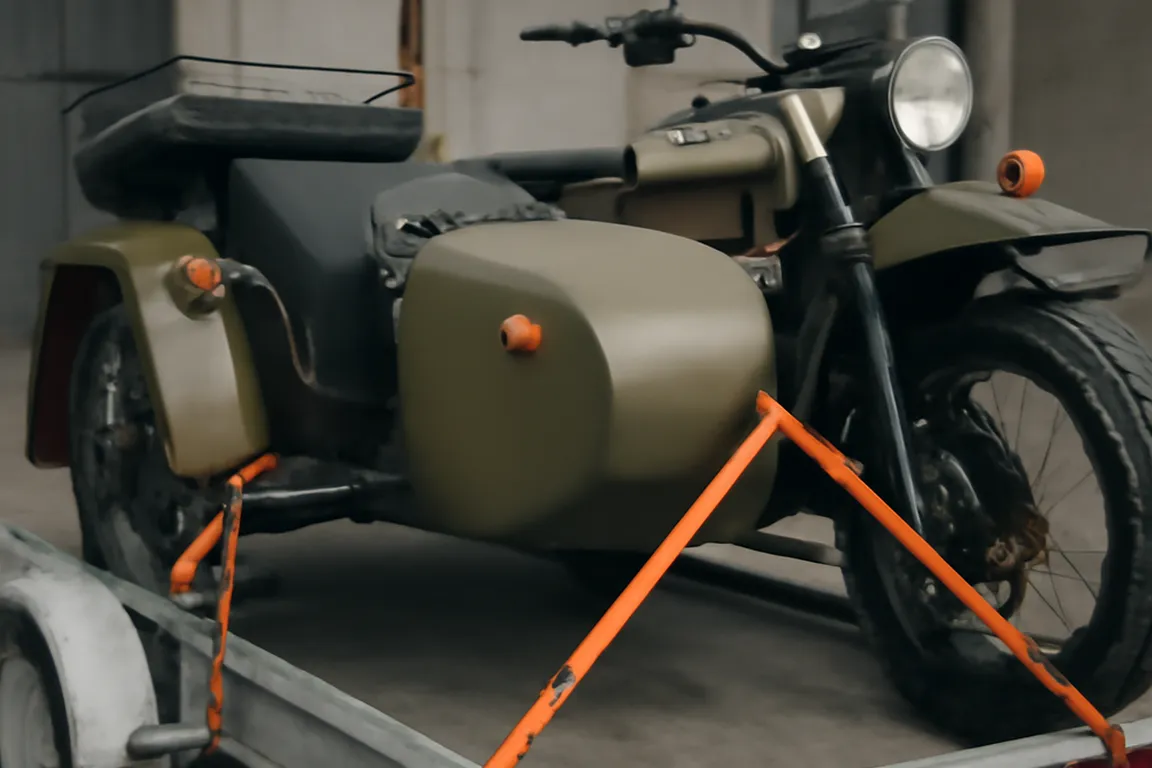
- Wheel chocks and asymmetric strapping: because of the sidecar’s off-centre weight, straps must be positioned to prevent the whole assembly shifting sideways under braking, not just fore-aft
- Tyre pressure check before loading: a flat or soft tyre makes loading dramatically harder and increases tip-over risk on the ramp
- Tie-down points: use the frame’s designated lashing points, never the sidecar body panels, which are not structural
- A second person for loading: an Ural sidecar on a ramp is not a one-person job to do safely the first time
For owners without their own equipment, trailer rental (typically €60-120/day depending on trailer size and region) combined with a compatible tow vehicle can still undercut a professional carrier’s price for shorter distances, though the time and physical effort involved should be weighed honestly against the savings.
Professional Motorcycle Transport Services
For longer distances, unfamiliar mechanical condition, or simply a lack of suitable trailering equipment, hiring a professional transport company is the most reliable option.
How Pricing Works
Most French motorcycle transport companies price on a sliding per-kilometre scale with a minimum charge floor. As a rough guide for a single vehicle on an open trailer, shared with other loads on the same run:
| Distance | Typical price range |
|---|---|
| Under 100 km | €150-250 (minimum charge applies) |
| 100-300 km | €250-450 |
| 300-600 km | €400-650 |
| 600-1000 km | €600-950 |
Enclosed transport, dedicated single-vehicle runs, and difficult access points (no lift-gate access, narrow streets, upper-floor parking) all add to the base price. Getting quotes from at least three carriers is worthwhile — pricing variance between companies for the same route is often 30-40%.
Choosing a Carrier Who Understands Sidecars
Not every motorcycle transport company has handled a sidecar before. This matters more than it might seem: an Ural’s weight is not distributed the way a solo motorcycle’s is, and a carrier who straps it down using solo-bike technique risks stressing the sidecar’s connecting struts or damaging the tub’s bodywork.
Questions worth asking before booking: have you transported sidecars before? How do you secure the third wheel? What insurance covers the vehicle in transit, and what’s the claims process if something goes wrong? A carrier who answers confidently and specifically is a better sign than one who says “it’s the same as any bike.”
If you’re new to the platform generally and still assessing what to look for in a used machine, our guide to buying a used Ural covers the mechanical checks worth doing before you even arrange transport — there’s little point paying to ship a machine with an undiagnosed problem.
Timing Around Licensing and Registration
If the transport is part of a first-time purchase rather than a move of a machine you already own, it’s worth sequencing paperwork sensibly around the transport date. Confirming you hold the appropriate driving qualification — for most Ural sidecars, a standard category B licence is sufficient, as detailed in our sidecar licence guide — before the machine arrives means you can ride it away immediately rather than leaving it parked while paperwork catches up. Registration formalities, particularly for a machine changing region or crossing a border, are also easier to complete calmly before transport day than rushed at the last minute once the carrier is already en route.
Importing an Ural from Russia: The Post-Sanctions Reality
Before 2022, importing a new Ural directly from the manufacturer’s Russian production or through European distributors sourcing directly from Russia was relatively straightforward. The sanctions regime introduced progressively from 2022 changed this landscape substantially.
What Has Changed
Banking restrictions on transactions with Russian entities make direct payment to a Russia-based seller legally and practically fraught for a private individual. Beyond the payment mechanism, logistics have shifted: Ural Motorcycles’ export operations have routed through third countries at various points — Kazakhstan, Armenia, Georgia and Turkey have all served as transit or re-export points depending on the period.
For the vast majority of French buyers, this means the practical route to a new Ural is through an authorised European distributor who has already navigated the sourcing chain, rather than attempting a direct private import. Our interview with a French Ural dealer discusses how the supply chain has adapted in recent years and what it means for delivery timelines. For a broader view of how the wider trade and industrial landscape around Ural has shifted since the sanctions, Association Ruslan covers the Franco-Russian cultural and economic exchange context that shapes this evolving supply chain.
Importing a Used Ural from Eastern Europe
A used Ural already registered within the EU (Germany, Poland, Baltic states) presents a much simpler picture than a Russia-origin import, since EU conformity is generally already established. The main steps:
- Obtain the European Certificate of Conformity (or confirm the vehicle already carries valid EU type-approval)
- Verify VAT status — if VAT was already paid within the EU and the seller is a private individual, no further VAT is generally due in France
- Register through the ANTS online platform with the foreign title, proof of purchase, and a recent technical inspection
- Arrange transport (trailer or professional carrier) across the border, checking any temporary transit documentation requirements with the exporting country
Customs and VAT for Non-EU Imports
Importing a used Ural from outside the EU (including, in specific documented cases, from Russia via a third-country intermediary) triggers customs duty and VAT that catch many first-time importers by surprise.
Approximate figures for planning purposes:
- Customs duty: roughly 6-8% of the declared value, calculated using EU depreciation schedules for used vehicles rather than the original purchase price
- VAT: 20%, applied to the declared value plus duty plus transport cost to the EU border — not simply on the purchase price
- Conformity certification: an individual approval process (or COC if available) through DREAL in France, which can take several weeks and cost several hundred euros depending on complexity
On a machine valued at €8,000, total additional charges before registration frequently reach €2,000-2,500. These are estimates; a customs broker can provide a binding calculation before you commit funds, and this step should never be skipped given how much these figures can shift with exchange rates and valuation disputes.
Insurance During Transport
Whether self-trailering or hiring a carrier, insurance coverage during transit deserves explicit attention rather than assumption.
For self-trailering, most standard motor insurance policies cover a vehicle being towed on a trailer, but always confirm this explicitly with your insurer rather than assuming — some policies distinguish between “in use” and “in transport” coverage with different terms.
For professional carriers, request the certificate of transport insurance and confirm it covers full replacement value, not a generic liability minimum. A carrier’s standard policy sometimes caps per-vehicle liability at a level well below an Ural’s actual value, particularly for a well-maintained or lightly modified example — read the fine print or ask directly.
Documenting Condition Before and After Transport
Whichever method you choose, photographing the machine thoroughly before it leaves and immediately upon arrival is cheap insurance against disputes. Cover:
- All four corners of the sidecar body and tub for existing scratches or dents
- Close-ups of the windscreen, mirrors, and any aftermarket accessories
- Odometer reading and fuel level
- Tyre condition and tread
Time-stamped photos (most smartphones embed this automatically) provide a clear before/after reference if a claim becomes necessary. This is a five-minute task that has saved many owners a difficult conversation with a carrier or insurer.
Planning the Logistics of Pickup and Delivery
For professional transport, clarify well in advance:
- Whether pickup/delivery is kerbside only or can reach a private driveway
- Whether a lift-gate is available, or whether the machine needs to be ridden a short distance to a loadable location
- Expected transit window (same-day, 24-48 hours, or longer for grouped runs covering multiple stops)
- Contact protocol if the delivery window shifts
Rural addresses, narrow village streets, and gated properties are common sources of last-minute complication — a phone conversation with the carrier’s dispatcher a day or two before pickup, rather than relying solely on a booking form, resolves most of these issues before they become a problem on the day.
Preparing the Machine Before It Travels
Whichever transport method you choose, a handful of preparation steps reduce risk and make the handover smoother, whether you’re loading it onto your own trailer or handing it to a carrier’s driver.
Drain or secure fuel appropriately: most trailer and carrier operators ask for a near-empty or low fuel level, both to reduce weight and to limit fire risk during transit. Confirm the carrier’s specific requirement before the pickup day rather than assuming a full tank is fine.
Disconnect or secure the battery: a battery that isn’t fully secured can shift during transit and short against the frame. A quick check of the battery strap or bracket takes two minutes and avoids a genuinely common cause of minor electrical faults reported after transport.
Check tyre pressures: correctly inflated tyres make loading onto a ramp meaningfully safer and reduce the chance of a tip-over during the loading process itself, which is when most transport-related damage actually occurs — not during the drive.
Remove or secure loose accessories: panniers, screens, and aftermarket lighting that aren’t permanently fixed should either be removed and transported separately or firmly secured, since vibration over a long transit can loosen fittings that feel secure on a short ride.
If the machine you’re arranging transport for is one you haven’t fully assessed mechanically yet — a common situation when transport is booked immediately after a purchase agreement — it’s worth pausing to review our used Ural buying guide checklist before the transport date, since a pre-existing mechanical issue is far easier to address before the bike travels than after.
Spare Parts and Post-Transport Checks
Once the Ural arrives at its destination, whether ridden, trailered, or shipped by a professional carrier, a short post-arrival check pays for itself. Inspect the sidecar body and tub for any new marks against your pre-transport photographs, check tyre pressures and battery connections again, and take the machine for a short local ride before committing to a longer trip.
If anything needs attention — a loose fitting, a component that shifted during transit — knowing where to source parts quickly matters. Our overview of Ural spare parts availability in France covers which components are readily stocked domestically and which typically require ordering from a specialist, a useful reference to have on hand immediately after a long-distance move in case something needs sorting out before the bike sees regular use again.
Cost Comparison Summary
| Method | Typical cost | Best suited for |
|---|---|---|
| Riding it yourself | Fuel + time | Distance under 400-500 km, known machine, good weather |
| Self-trailering | €60-150 (rental) + fuel | Owner with tow vehicle access, mid-distance moves |
| Professional open transport | €250-950 depending on distance | Long distance, unknown mechanical condition, no trailer access |
| Professional enclosed transport | +30-50% over open rates | High-value or freshly restored machines |
| Cross-border EU import | Transport + registration fees, no customs duty | Used Ural already registered within the EU |
| Non-EU import (customs applicable) | Transport + ~26-28% duty/VAT combined + certification | Rare private cases; most buyers go through an authorised distributor instead |
For readers based in Russia-adjacent or Eastern European regions following this topic from the francophone diaspora angle, the wider context of trade routes and logistics between France and Russia is covered in more depth on Gazeta France-Oural, a useful complementary source for the broader picture beyond motorcycle transport specifically.
Final Recommendations
For most French buyers, the pragmatic path is: ride it yourself under 400 km on a known machine, trailer it yourself if you have the equipment and a moderate distance, and default to a professional carrier experienced with sidecars for anything longer or involving an unfamiliar machine. Direct import from Russia, while not strictly impossible, has become complex enough that working through an authorised European distributor remains the sensible route for the overwhelming majority of buyers in 2026.
Whichever path you take, budgeting realistically for transport costs — and factoring them into your total acquisition budget before you commit to a purchase — avoids an unpleasant surprise once the excitement of finding the right machine has already taken hold.
Frequently Asked Questions
It depends on distance, the bike's mechanical condition and the season. Under 300-400 km on a machine that has just passed inspection, riding it back is often the most economical and enjoyable option, provided you plan fuel stops (the Ural's range rarely exceeds 200 km) and check basic mechanicals beforehand. Beyond 500 km, especially for a machine bought unseen or with unknown maintenance history, professional transport removes the risk of a breakdown far from home and avoids adding hours of wear to a bike you don't yet know well. Many buyers also factor in available time: a transporter can deliver in 24-48 hours what a leisurely ride would take three or four days to cover with proper rest stops.
For a single sidecar transported on an open trailer within mainland France, expect roughly €0.80 to €1.50 per kilometre for the first 200 km, decreasing on a sliding scale beyond that, with many carriers applying a minimum charge of €150-250 regardless of distance. A Paris-to-Marseille run (around 780 km) typically lands between €450 and €700 depending on the carrier, whether the sidecar is picked up curbside or requires a lift-gate, and whether it's grouped with other vehicles on the same run. Enclosed transport, better suited to a freshly restored or particularly valuable Ural, commands a premium of 30-50% over open trailer rates.
Direct commercial import from Russia has become significantly more complicated since the sanctions regime introduced from 2022 onward. Ural Motorcycles' own export operations have shifted logistics through third markets — Kazakhstan, Armenia, Georgia and Turkey have all served at various points as transit points for machines eventually reaching European buyers. A private individual attempting a direct import must navigate banking restrictions on Russian-origin payments, customs classification questions, and European conformity certification that a Russia-originated vehicle does not automatically hold. In practice, almost all Urals reaching French buyers today pass through an authorised European distributor who has already resolved these issues upstream.
For a used vehicle imported from outside the EU, French customs generally apply a duty rate around 6-8% of the declared value (calculated on a depreciated basis for used vehicles, following EU customs valuation rules) plus 20% VAT on the total (declared value plus duty plus transport cost to the EU border). On a machine valued at €8,000, this can add €2,000-2,500 in total charges before the vehicle can be registered. Additional costs include the mandatory conformity certification (COC or an equivalent individual approval, DREAL inspection in France) which can run several hundred euros and take weeks to process. These figures are indicative — always request a written estimate from a customs broker before committing to an import.
Verify the carrier holds appropriate transport insurance covering the full replacement value of your machine, not just a generic liability policy — ask for the certificate, not just a verbal assurance. Confirm how the sidecar will be secured: an Ural's asymmetric weight distribution (engine and gearbox offset toward the sidecar side) means straps must account for this, and a carrier unfamiliar with sidecars sometimes secures it as if it were a solo motorcycle, risking damage to the sidecar body or suspension during transit. Ask about pickup and delivery logistics (kerbside only, or can they access a private driveway with a lift-gate), expected transit time, and whether photographic condition reports are taken at both ends — this last point matters enormously if a dispute arises over transport damage.