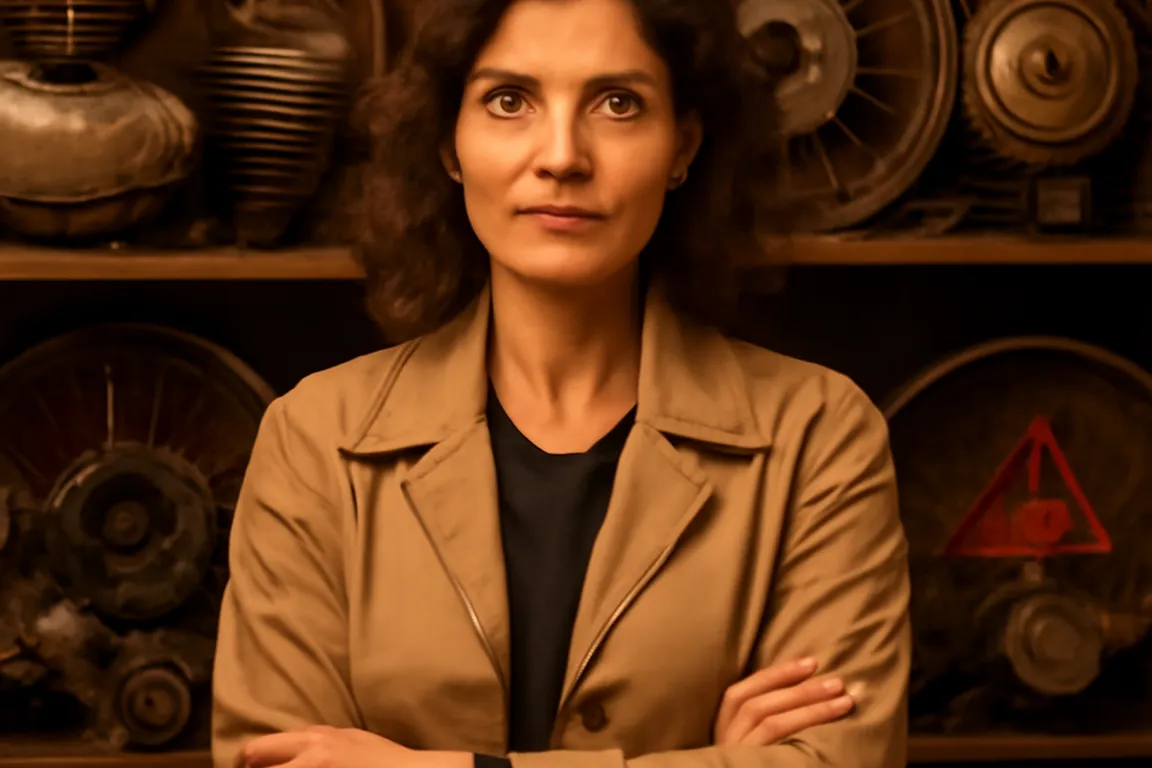
Meeting with Élise Vasseur, who has traded in original Ural, Dnepr and MZ parts for over a decade. She talks about distinguishing genuine Soviet-era components from modern copies, the French motorcycle flea-market circuit, and the human stories she uncovers along the way.
Interview conducted by Marc Antoine Girard, Ural-France editorial team.
Élise Vasseur’s workshop, tucked behind a courtyard in Lyon’s Guillotière district, looks less like a parts store and more like an archive. Wooden crates line every wall, hand-labelled in fading marker: “Dnepr MT-11 gearbox 1978-82”, “Ural carbs — needs sorting”, “MZ electricals — DO NOT TOUCH (sorted!)”. She has spent twelve years building this collection, one flea market and one estate sale at a time, and she can date a casting within a five-year window just by running a thumb over its surface.
Her clients range from Ural owners simply hunting a single hard-to-find gasket to full restoration projects bringing a decades-old Dnepr back from a barn find. What unites them, she says, is that almost nobody arrives already knowing how to tell an authentic Soviet-era part from a modern reproduction — a skill she has spent over a decade refining, one flea market table at a time.
Élise Vasseur: I inherited a Dnepr from my grandfather, a machine he’d brought back from a work posting in Poland in the 1980s. It didn’t run. I took it to a general mechanic who told me, quite bluntly, that he had no idea where to even start sourcing parts for it. So I started looking myself. And I discovered this entire hidden world — collectors, small-ad networks, people hoarding crates of Soviet-era components in barns because “you never know.” I got the Dnepr running within eight months, mostly through trial, error, and a lot of coffee with strangers at flea markets. Somewhere in that process, sourcing the parts became more interesting to me than riding the bike. I never really stopped.
I should say that back then I knew almost nothing about proper Ural or Dnepr maintenance either — I was learning everything from scratch at the same time, reading whatever I could find, including some fairly basic motorcycle maintenance guidance that at least gave me a mechanical vocabulary before I dove into the parts side specifically.
ÉV: Weight and finish, first of all. Soviet factories at Irbit and Kiev were not chasing elegance — they were producing rugged, over-engineered components with the tolerances available to them at the time, which were looser than what we consider standard today. That means original castings are often heavier, with visible casting seams, sometimes slightly asymmetric. A modern reproduction, made with contemporary tooling, comes out lighter, smoother, more “perfect” — and that perfection is precisely the giveaway.
Then there are the markings. Genuine parts almost always carry a Cyrillic stamp somewhere — a factory code, a date stamp, sometimes a quality-control inspector’s mark. Reproductions either omit this entirely or, more deceptively, add a fake Cyrillic stamp that doesn’t correspond to any real factory code. I keep a small reference book of authentic Irbit and KMZ codes precisely because of this. If someone shows me a stamp I don’t recognise, I dig before I trust it.
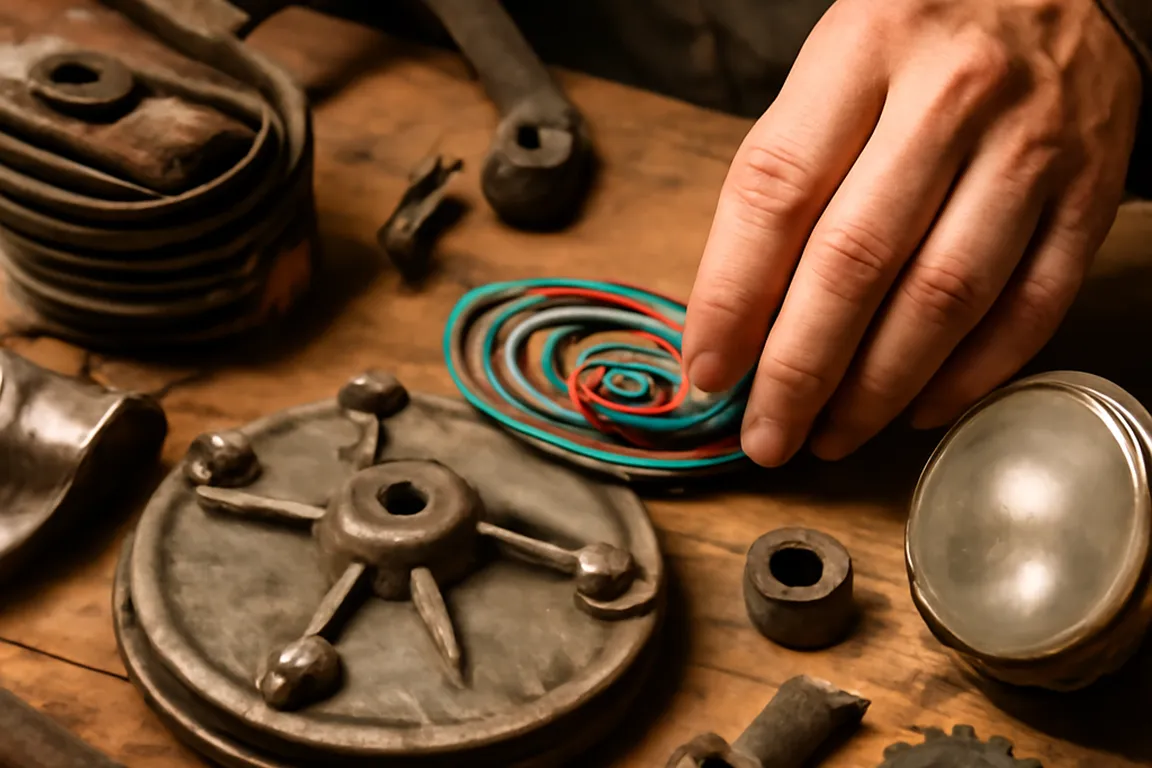
ÉV: There’s one I still tell at every dinner. A seller at a bourse near Chalon-sur-Saône had a whole box of “NOS” — new old stock — Ural carburettor rebuild kits, complete with faded Soviet-style packaging. Beautiful presentation, aged paper, the works. Something felt off though — the gasket material inside was too flexible, too modern. I asked to smell one, which got me a strange look, but old Soviet rubber gaskets from that era have a very distinct mineral smell from the compounds used. These smelled like fresh synthetic rubber. Turned out the packaging had been carefully reproduced and aged artificially, then stuffed with genuinely modern reproduction gaskets. Clever, but not clever enough. I didn’t buy, and I made sure to mention it quietly to a few trusted contacts afterward — that’s how the community protects itself.
ÉV: French flea markets and bourses d’échanges are still the backbone of this world, even in the internet era. Certain regional events — I won’t name all of them, some are semi-secret by design — attract sellers who specifically bring Soviet and Eastern Bloc motorcycle parts because they know a buyer will show up. Beyond that, online forums and specialist groups matter enormously, but reputation there is everything. I always recommend that beginners spend their first few outings just looking and asking questions rather than buying. Learn to recognise the vocabulary, the typical prices, the usual suspects among sellers, before committing money.
A parallel piece of advice: if you’re also new to owning the machine itself, not just its parts, it helps enormously to first understand what you’re actually restoring or maintaining. Someone shopping for a used Dnepr or an older Ural without having read a proper used-buying guide often ends up chasing parts for problems that a careful pre-purchase inspection would have caught in the first place.
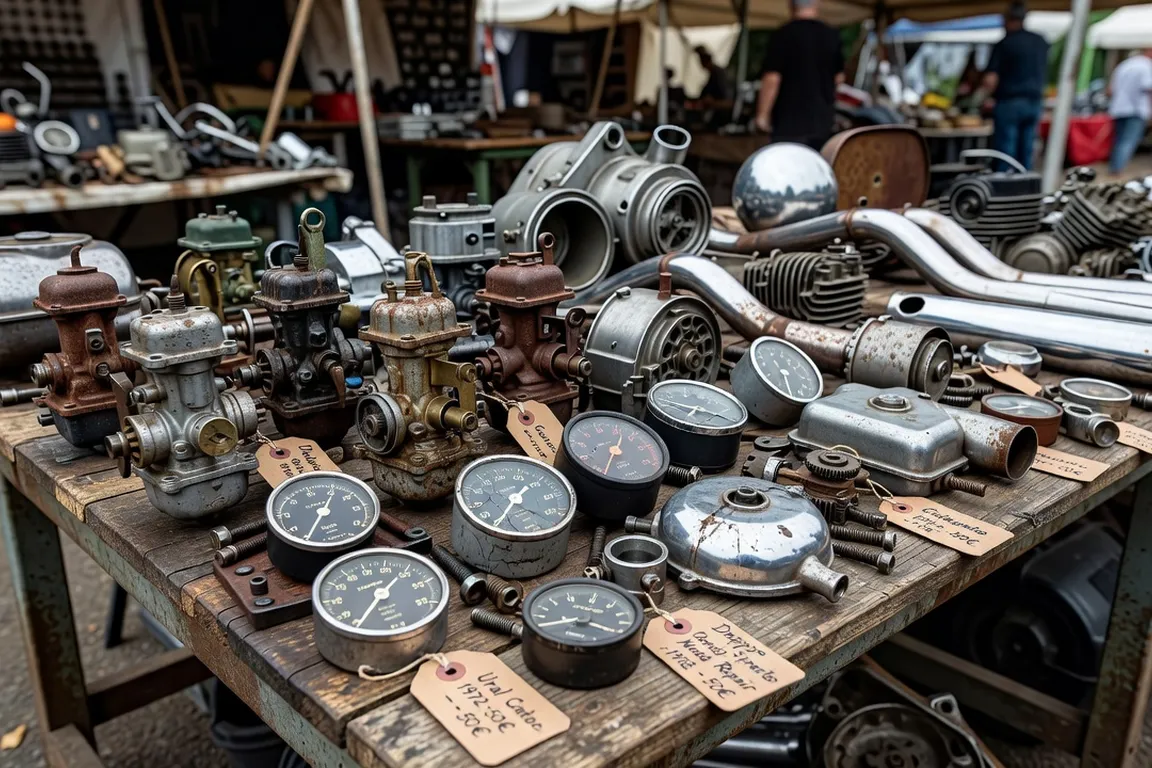
ÉV: They’re social institutions as much as commercial ones. I’ve learned more mechanical history standing at a folding table drinking bad instant coffee than from any manual. Sellers who’ve been doing this for thirty or forty years carry an oral history of these machines that simply isn’t written down anywhere — which factory batch had a particular flaw, which importer brought certain models into France in which decade, who used to own a specific rare part before it changed hands three times. If you’re only there to transact, you miss ninety percent of the value. I go for the stories as much as the parts, honestly, and often the stories tell me more about a part’s authenticity than any visual inspection would.
There’s also a practical side to this social fabric that beginners underestimate: these are the same people who will tip you off when something genuinely rare surfaces, long before it reaches any public listing. That kind of early access simply isn’t available to someone who shows up once, buys a cheap gasket, and never comes back.
ÉV: A gentleman in his eighties once sold me a full set of Ural front fork components that had sat, wrapped in oiled cloth, in his cellar since the early 1970s. He’d bought a Ural through an unusual import channel back then, imagining road trips across Europe with his wife. Life intervened — children, a business, illness — and the bike itself was sold decades ago, but he’d kept a box of spares “just in case.” Handing them to me, he said something like: “At least someone will actually use them now.” I still think about that box every time I sell one of those fork components to a customer restoring their own Ural. There’s a whole unfinished road trip embedded in that metal.
I try, whenever I can, to pass that story along with the part itself when I resell it. Most buyers genuinely appreciate knowing where a component has been, who owned it, what it almost became part of. It doesn’t change the mechanical function of the part, obviously, but it changes how people treat the machine once it’s finished. A restoration built partly from parts with real history behind them tends to be cared for differently than one assembled purely from anonymous stock.
ÉV: Enormously, and not entirely for the worse. Ten years ago, if a specific gasket or cable failed on an old Dnepr, you genuinely might wait months to find an original, at a painful price. Reproduction manufacturers filling that gap has been a real service to owners who simply want their machine running reliably. My concern isn’t the existence of these parts — it’s transparency about what they are. A well-made modern reproduction sold honestly as such is a perfectly good solution for a daily rider. The same part sold dishonestly as “genuine NOS Soviet stock” at triple the price is fraud, plain and simple, and unfortunately it happens more than people realise, especially in online marketplaces with no accountability.
ÉV: Buying based on a photo alone, especially online, without asking for weight, close-up markings, or the story of where the part came from. A good photo can hide a lot. I also see people overpay dramatically for cosmetic “patina” — rust and grime staged to look like decades of honest wear — when the underlying part is actually a fairly recent, poorly-aged reproduction. Patience is the real skill in this hobby. The right part, at the right price, from a seller you can trust, will come along if you wait. Panic-buying the first thing that looks plausible is how people end up with a shelf full of expensive fakes.
The second most common mistake, closely related, is assuming that a higher price automatically signals authenticity. Some of the most convincing fakes I’ve encountered were priced deliberately high, precisely because buyers unconsciously associate a steep price tag with genuine rarity. Trust the physical evidence — weight, markings, provenance story — far more than the number on the tag.
ÉV: Original Soviet-era stock is, by definition, a finite and slowly shrinking resource — every year, a certain amount gets used, damaged, or simply lost to time. What I do expect to keep improving is the quality and honesty of the reproduction-parts market, since demand for reliable Urals — including current-production ones needing certain compatible components — continues to grow among younger riders. If you’re curious how that broader spare-parts landscape looks today, from official channels to independent suppliers, it’s worth reading a solid overview of the current Ural spare parts situation in France before deciding which route suits your machine.
ÉV: Arrive early — the best pieces move fast and quietly, often before the market officially opens to the general public. Bring cash in small denominations; it makes negotiation smoother and faster. Bring a notebook, or at least your phone, to note down sellers, prices, and part references even for things you don’t buy that day — you’ll want that information later. And above all, talk to people. Ask questions. Buy a coffee for the old man who’s clearly been doing this since before you were born. The parts matter, but the relationships you build are what will actually get you the good stuff, year after year, long before it ever reaches a public listing.
ÉV: Logistics is honestly half the job, and people underestimate that. I keep a dedicated storage unit on the outskirts of Lyon, roughly 80 square metres, entirely given over to inventory. Every part gets catalogued with a photo, its provenance, and an estimated value — without that discipline, I would quickly lose track of what I actually own, especially for smaller components that look nearly identical across different models.
Preservation itself depends a lot on material. Untreated metal parts — certain crankcases, original fasteners — need protection from humidity to prevent corrosion, so I keep them lightly oiled and, where possible, in sealed crates. Rubber and period plastic components, more fragile with age, are kept at a stable temperature away from direct light, which accelerates their degradation considerably. I also rotate stock regularly: anything that sits unsold for more than two years gets reassessed, sometimes repriced or featured more prominently at major gatherings. Stock that just sits earns nothing and takes up space — better to sell slightly under value than leave a part frozen indefinitely.
Five quick-fire questions
1. All Soviet-era Ural parts are marked in Cyrillic. False — many small fasteners and generic components carry no marking at all; only certain castings and factory-produced assemblies bear stamps.
2. Weight is a reliable first indicator of authenticity. True — original castings are almost always heavier than modern reproductions of the same part.
3. Reproduction parts are always inferior to originals. False — quality varies widely, and many modern reproductions are perfectly reliable, sometimes better suited to daily use than a 40-year-old original.
4. Flea markets remain the best source for rare vintage parts in France. True, according to Élise — combined with trusted specialist networks, they still outperform blind online searches.
5. Patina always indicates genuine age. False — artificial aging of reproduction parts and packaging is a known and increasingly sophisticated practice among less scrupulous sellers.
Élise Vasseur’s final advice
- Learn to recognise genuine Cyrillic factory codes before trusting any “original” claim.
- Judge weight and casting finish first — perfection is often the sign of a modern copy.
- Buy your first few parts slowly, prioritising learning over acquiring.
- Build real relationships with sellers rather than chasing single transactions.
- Be transparent yourself about reproduction versus original when you resell — the community’s trust depends on it.
- Don’t panic-buy the first plausible-looking part; patience nearly always pays off.
- Keep a personal reference log of sellers, prices, and part codes over time.
- Accept that some Soviet-era stock is genuinely running out — plan restorations accordingly.
- Consider modern manufacturer parts for components under real mechanical stress.
- Never underestimate the value of the stories behind a part — they often confirm authenticity better than any physical test.
Find more on keeping an Ural running well in our maintenance guide and our overview of the current Ural spare parts situation in France. For a broader look at Soviet motorcycle heritage and culture, see Héritage Russe.
Frequently Asked Questions
Original Soviet parts almost always carry a stamped Cyrillic marking, a batch number, and sometimes a small factory logo (IMZ diamond or a simple triangle depending on the era). The metal casting is generally rougher, heavier, and less uniform than modern reproductions, which tend to be lighter, smoother, and often unmarked or marked with a generic part number in Latin characters. Thread pitch is another giveaway: original Soviet fasteners frequently use metric threads that are slightly non-standard compared to current ISO tolerances, so a modern nut may thread on with unusual resistance. When in doubt, weight and surface finish are the fastest tells — pick the part up, and if it feels suspiciously light and perfectly finished, it is almost certainly a recent copy.
The safest sources are established specialist dealers who can show provenance, the classic-bike stands at recognised flea markets (Rétromobile satellite events, the big regional bourses d'échanges), and vetted online communities where sellers have a track record and public feedback. Avoid buying blind from random marketplace listings with a single blurry photo — ask for close-ups of markings, weight, and the reverse side of any casting. A reputable seller will always answer detailed questions without hesitation; reluctance to provide extra photos is itself a warning sign.
Not necessarily — quality varies enormously. Some reproduction gaskets, cables, and electrical parts are perfectly serviceable and considerably cheaper than hunting for a 40-year-old original. The real issue is when a reproduction part is sold, knowingly or not, as an original — that inflates the price unfairly and can mislead a future buyer if the machine is resold as fully authentic. For parts under real mechanical stress (gearbox internals, certain bearings), I generally recommend a trusted modern manufacturer over an unknown-condition 40-year-old part, since metal fatigue in old Soviet steel is not always visible to the eye.
Show up early, be visibly knowledgeable but humble, and buy something small on your first visit even if it's not essential — it establishes you as a serious buyer rather than a tire-kicker. Ask sellers about the history of a part rather than just its price; most collectors love telling the story of where something came from, and that conversation is often more valuable than the part itself. Come back to the same market regularly. Reputation in this world is built over years, not single transactions, and the best deals are rarely advertised — they are offered quietly to people the seller already trusts.
It depends entirely on your goal. If you are restoring a machine for concours-style authenticity or historical preservation, an original part — even non-functional and later refurbished by a specialist — carries value that no reproduction can replace. If your Ural is a daily rider and reliability matters more than provenance, a modern equivalent part is usually the wiser choice, keeping the original as a display piece. I always ask new clients which category they fall into before recommending anything, because the right answer changes completely depending on the use case.