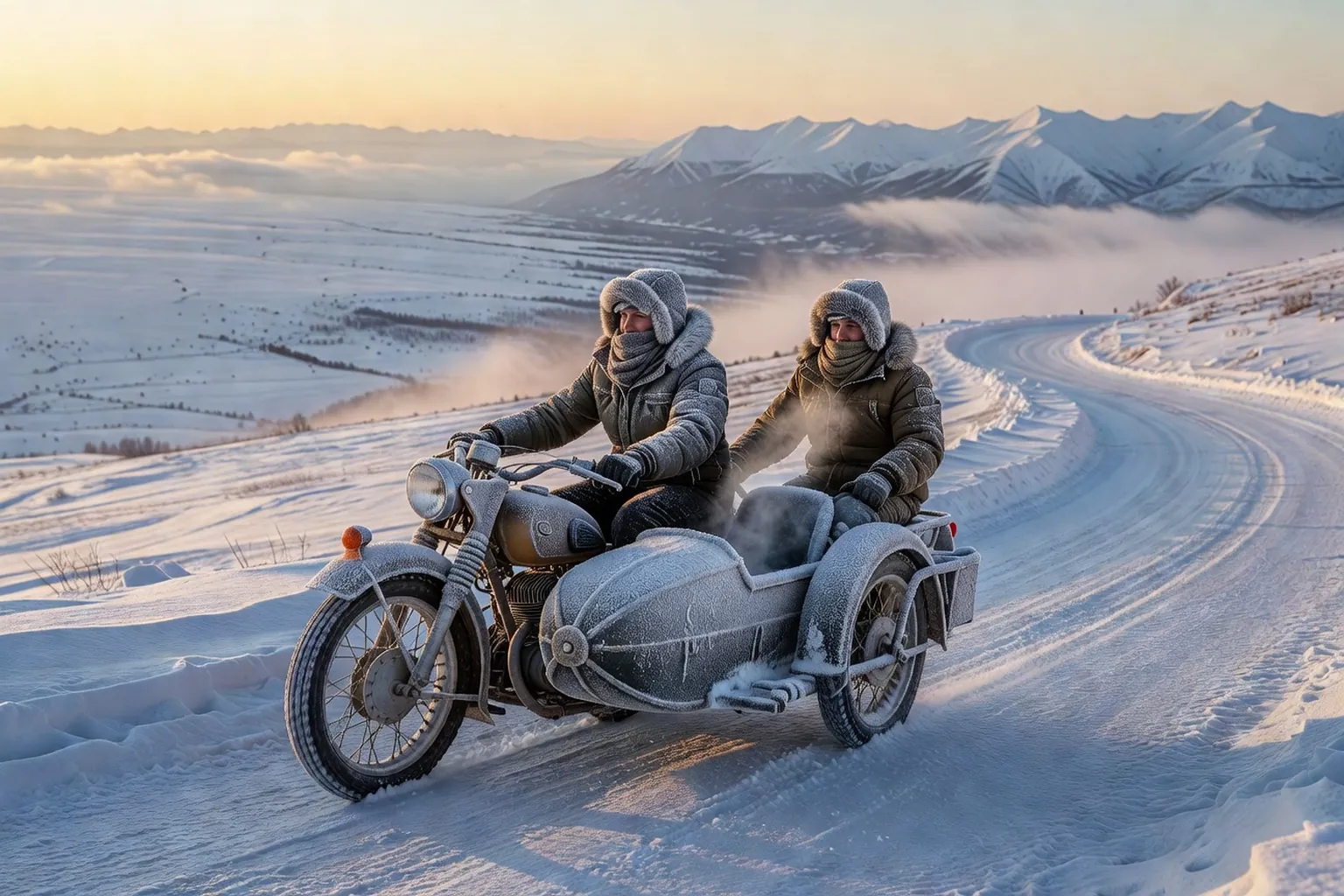
The Ural is one of the rare motorcycles that remains usable in winter thanks to its three-wheel stability. This guide covers complete winter preparation: mechanical, equipment and cold-weather riding technique.
The Ural: The Motorcycle That Loves Winter
Against all expectations, winter is often the favourite season of seasoned Uralists. The reason is simple: three-wheel stability removes the fear of lateral sliding that paralyses solo motorcyclists at the first frost. On packed snow or lightly iced road, a well-prepared Ural offers a unique experience — and often more beautiful landscapes than summer.
The absolute condition: preparation. An unprepared Ural can become dangerous in cold weather, particularly due to cable stiffening and excessively viscous cold-start oils. This guide covers all aspects of winterisation and cold-weather riding.
Key takeaway: Three-wheel stability makes the Ural genuinely safer than a solo motorcycle on ice and packed snow — but only with proper winter preparation: lower-viscosity oil below 5°C, a maintained battery, and lubricated cables. Skip the prep and the same machine becomes a liability.
Winter Mechanical Preparation
Engine Oil: Viscosity Is Everything
In European winters (temperatures commonly between -5°C and +5°C), standard 15W-40 engine oil can be too viscous in the cold. The risk: during the first five seconds after start-up, the oil pump struggles to distribute lubrication throughout the engine. This is when wear is greatest.
Solution: switch to 10W-40 when temperatures regularly drop below 5°C. Below -10°C, 5W-40 is recommended. These oils are commonly available at any motor factors.
Note: modern Urals (EFI, post-2015) handle cold starts better thanks to injection mapping that enriches the mixture during the warm-up phase.
Battery and Electrics
The Ural’s original battery is sized for normal conditions. In extreme cold, it may struggle to provide the cranking current needed. Symptoms: slower starter, dimmer warning lights.
Prevention:
- Check battery charge in autumn (voltmeter: 12.6V at full charge)
- Use a battery maintainer (€20-40) when the bike is parked for more than 48 hours
- If battery is over 3 years old, replace it before winter (budget €50-80)
Cables and Controls
Sheathed cables tend to stiffen in cold, making the throttle less smooth and the front brake less progressive. Prevention:
- Degrease cables in late summer
- Lubricate with dedicated cable oil (cable pointing down, oil poured into sheath by capillary action)
- Check cable free play — it increases slightly in cold weather (sheath contraction)
Rider Equipment for Winter
An Ural being an open vehicle, cold is felt far more than in a car or SUV. Winter equipment is non-negotiable.
Thermal base layer: Merino wool or synthetic thermal underwear — avoid cotton which retains moisture. Thermal leggings under motorcycle trousers.
Jacket and trousers: models with Gore-Tex or equivalent membrane, removable thermal lining. Avoid summer jackets that let wind through.
Gloves: this is the critical point. Hands get coldest. Either heated electric gloves (€60-150 investment, powered from bike battery via USB socket), or thick winter gloves with handlebar wind deflectors.
Boots: waterproof boots with thermal insulation. Summer motorcycle boots become dangerously uncomfortable below -5°C.
Helmet: a full-face helmet is noticeably warmer than a jet helmet. Below 0°C, wear a Merino balaclava under the helmet.
Cold-Weather Riding Technique
On Wet Roads
Wet roads change few reflexes compared to normal riding, other than:
- Braking distances lengthened by 30-50%
- Smooth acceleration transitions
- Extra vigilance at road markings (white paint = slippery)
On Ice
This is where the Ural excels over a solo motorcycle. Three wheels offer stability a solo motorcycle cannot match. Techniques:
- Reduced speed (40-50 km/h maximum on ice)
- Very progressive braking — avoid wheel lock
- Engine braking (progressive downshifting)
- Avoid stopping on uphill sections (restart difficult)
On Packed Snow
With mixed tyres (Gear Up), progress on 2-5 cm of snow is possible at 30-50 km/h. With 2WD engaged, the Gear Up becomes remarkably capable. The sidecar wheel, carrying less load than the motorcycle wheels, tends to slip first — that’s the signal to reduce speed or engage 2WD.
In Strong Wind
The sidecar creates a lateral surface that catches wind. In strong crosswind (>50 km/h), the Ural requires constant steering corrections. Reduce speed and be ready to correct more frequently than in calm conditions.
Cold-Start Precautions
Below -10°C, starting an Ural requires some precautions:
- Don’t force the starter for more than 5 seconds (overheating risk)
- Wait 10-15 seconds between attempts
- Let the engine idle for 3-5 minutes before setting off
- Don’t accelerate hard before the temperature gauge stabilises
- If start-up fails after 5 attempts: get assistance (jump leads, external battery)
The EFI Ural generally starts without issue down to -15°C with a good battery and the right oil. Below -20°C — genuinely polar conditions — heated indoor storage or special preparation is required.
For complete maintenance procedures, including oil change and battery inspection, see our Ural motorcycle maintenance guide.
Frequently Asked Questions
Yes, the Ural sidecar is one of the most snow-adapted two and three-wheeled vehicles. Its three-point contact stability makes it far safer than a solo motorcycle. The Gear Up with its mixed tyres and 2WD is particularly effective. On packed snow and ice, motorcycle snow spikes or chains improve traction further.
Below 5°C, replace standard 15W-40 oil with 10W-40 or 5W-40. The lower cold viscosity facilitates oil pumping at start-up and reduces wear during the first engine revolutions. Ensure your oil is compatible with OHV engines (minimum API SM/SN rating).
Standard Ural lead-acid batteries lose capacity in cold weather (up to 50% at -15°C). If you use the motorcycle regularly in winter, invest in an AGM battery which tolerates charge/discharge cycles better at low temperatures. Otherwise, use a battery maintainer (Battery Tender) when the bike is parked.
Apply an anti-freeze lubricant (WD-40 Specialist Anti-Corrosion type) on cable joints and control pivots. For the handlebars, wind deflectors (Barkbusters or equivalent) considerably reduce the sensation of cold on hands. Check throttle and brake cables before every winter outing.
If you store the Ural for more than 6 weeks in winter, winterisation is needed: oil change and refill (used oil is acidic), full fuel tank + stabiliser additive, battery on maintainer, tyres off the floor if possible, anti-rust protection on exposed metal surfaces. These precautions avoid unpleasant spring surprises.