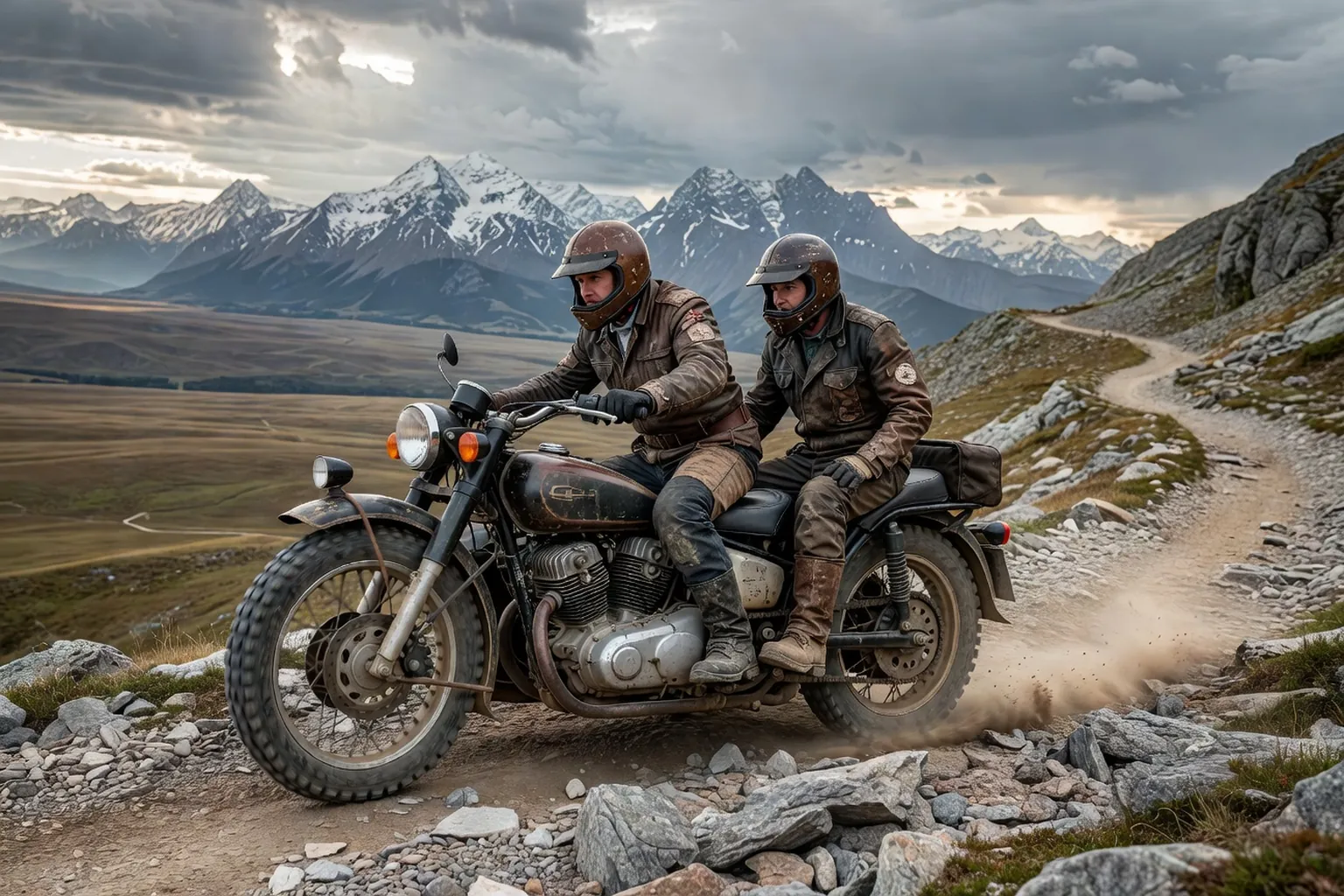
The Ural Gear Up and its 2WD system make the sidecar one of the rare two and three-wheeled vehicles genuinely capable off-road. This guide explains how to exploit it effectively and safely.
Why the Ural is Unique Off-Road
In the world of off-road motor vehicles, the Ural occupies an absolutely singular niche. Trail and enduro bikes offer superior agility. Quads and SSV (buggy) offer more power and stability. But none of these vehicles allows carrying a passenger in comfort while tackling off-road obstacles.
That’s precisely the Ural Gear Up’s unique proposition: a three-wheeled vehicle with a comfortable passenger seat, capable of venturing off paved roads thanks to its 2WD drive system.
This combination exists nowhere else in worldwide series production. It explains the particular attachment Gear Up owners have to their machine.
Key takeaway: The Gear Up’s off-road appeal is its rare combination of two-wheel-drive traction and a comfortable passenger seat — no other production vehicle offers both. Engage 2WD only below 30-40 km/h, and respect the machine’s real limits (rocky terrain, slopes over 30-35%, mud beyond 40-50 cm).
The 2WD System in Detail
The Gear Up’s 2WD transmission is a relatively simple mechanical mechanism in principle. At the rear, a second drive shaft (parallel to the main shaft) can be engaged via a coupling mechanism actuated by the left-side lever.
When 2WD is disengaged (standard 1WD mode): only the motorcycle rear wheel is driven. The sidecar is passively towed.
When 2WD is engaged: the sidecar wheel also receives drive, via a simplified differential. Torque is shared between the two driven wheels.
Important: 2WD should only be engaged at speeds below 30-40 km/h. Engaging it on road at higher speed creates significant mechanical stress on the transmission and steering.
Off-Road Riding Technique
The Golden Rule: Read the Terrain
Off-road, reading terrain ahead is crucial. An obstacle that surprises you on tarmac can stop an Ural on soft ground. Observe:
- Ground hardness (dry, damp, waterlogged?)
- Rut depth (a 20 cm rut can catch the sump)
- Gradient and camber
- Rocky obstacles (even small ones can snag the sidecar)
Low-Speed Progression
Off-road, ideal speed is 15-30 km/h. This pace maintains traction without risk of over-revving on loose ground. 2nd or 3rd gear depending on incline.
Uphill: medium-high engine revs, don’t stall, avoid stopping mid-slope if possible.
Downhill: engine braking (downshifting), very progressive physical braking. On very slippery terrain, first gear with engine braking alone is often safer than physical braking which risks wheel lock.
Managing Obstacles
Deep mud (>15 cm): Engage 2WD. Maintain engine revs, avoid excessive wheel spin (sinking risk). If a wheel spins, close the throttle slightly and let traction re-establish.
Soft sand: sand is treacherous. An Ural can progressively sink without noticing. In 2WD, progress is possible if speed is maintained (15-25 km/h). Stopping in deep sand often requires the winch to restart.
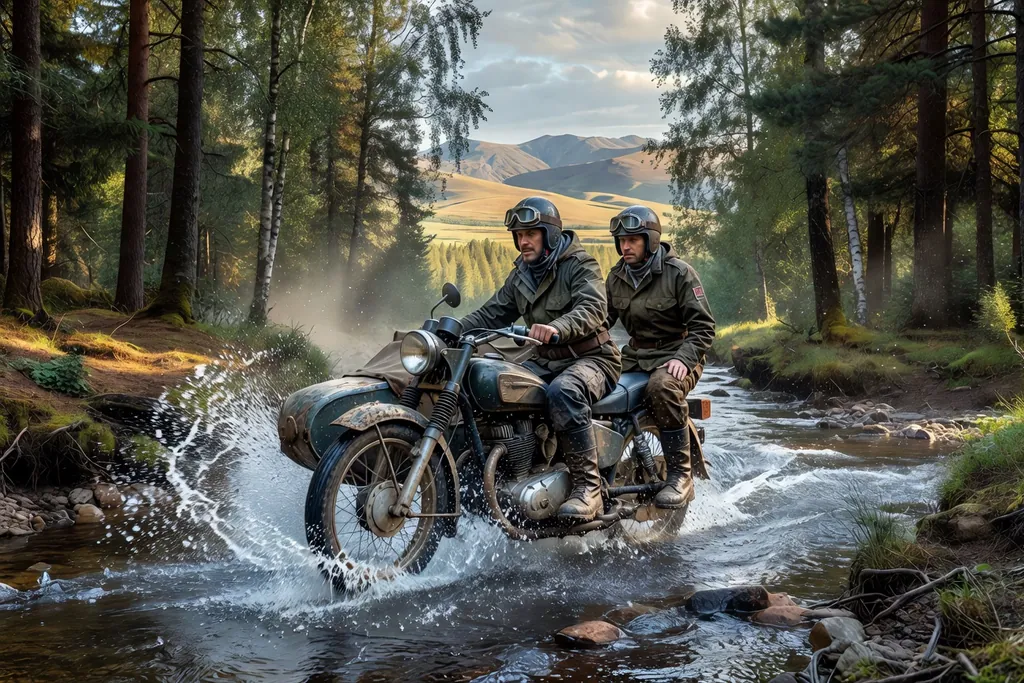
Stream crossing: possible to approximately 30-40 cm depth. Beyond that, engine flooding risk increases. Check depth on foot first. Maintain engine revs to create a bow wave ahead of the exhaust.
Machine Preparation for Off-Road
Essential Protections
Engine sump: this is the most exposed component. In standard configuration, the Ural’s aluminium sump is directly above the ground. An aluminium or polyethylene sump guard (€50-150) is essential investment for regular off-road.
Mudguards: original mudguards are often insufficient off-road. Mudguard extensions (flexible plastic) prevent mud accumulating around the chain or cables.
Appropriate Tyres
The Gear Up’s original tyres (mixed road/off-road) are adequate for occasional off-tarmac use. For serious off-road, more aggressive tread tyres (Heidenau K60, Mitas E-08) improve traction on soft ground.
Note: tyre changes slightly alter road behaviour. Off-road tyres are generally noisier on road and wear faster.
Spare Wheel
The Gear Up’s spare wheel is one of the most practical features for off-road. In case of puncture on difficult terrain, having a spare wheel directly on the machine eliminates the need for roadside assistance. Removing and refitting the sidecar wheel are simple operations with the supplied tools.
Limits to Respect
The Ural Gear Up is a versatile sidecar, not an extreme off-road vehicle. The following situations exceed its normal capabilities and risk damaging the machine or creating dangerous situations:
- Abrasive rocky terrain (rim and sidecar body damage risk)
- Slopes exceeding 30-35% (traction limit even in 2WD)
- Mud deeper than 40-50 cm (flooding risk)
- Vertical obstacles over 25 cm (ground clearance limited)
- Very narrow terrain below 1.5 m width (Gear Up total width ~1.4 m)
Respecting these limits ensures enjoyable off-road outings without machine damage.
For maintenance after each off-road outing (cleaning, ball joint checks, steering inspection), our mechanical maintenance guide details the points to systematically check.
Frequently Asked Questions
The Gear Up is not an enduro or quad. It won't tackle a narrow single track or a rocky cliff. However, it's perfectly capable on forest tracks, wide hiking paths, sand beaches, wet meadows and muddy tracks that many vehicles won't cross. Its three-wheel stability and 2WD make it surprisingly capable for a sidecar.
Recommended terrain: forest tracks (hard-packed earth, gravel, light mud), wide hiking trails, out-of-season beaches, high grass woodland, farm tracks. Avoid: very rocky terrain (rim damage risk), slopes >25% without a clear route, motocross tracks (too narrow), deep marsh.
A few simple preparations significantly increase capability and safety: mixed or knobbly tyres (if not already fitted), ground clearance verified (sump protected?), winch tested, tie-down straps on the sidecar body, emergency tow rope. For serious outings, an aluminium sump guard is recommended.
The Gear Up winch is an entry-level electric winch (500-800 kg capacity depending on model). It's used with the machine stopped, cable tensioned toward a fixed anchor (tree, rock). Engage the winch holding the remote away from the machine. Don't use it on slopes >45° or to move a completely embedded machine (overload risk).
Yes, a Tourist without 2WD can venture onto undemanding terrain (dry forest track, short grass). However, as soon as terrain becomes slippery or gradient steepens, the limits of 1WD become apparent quickly. For regular off-road, the Gear Up with 2WD is the clear choice.