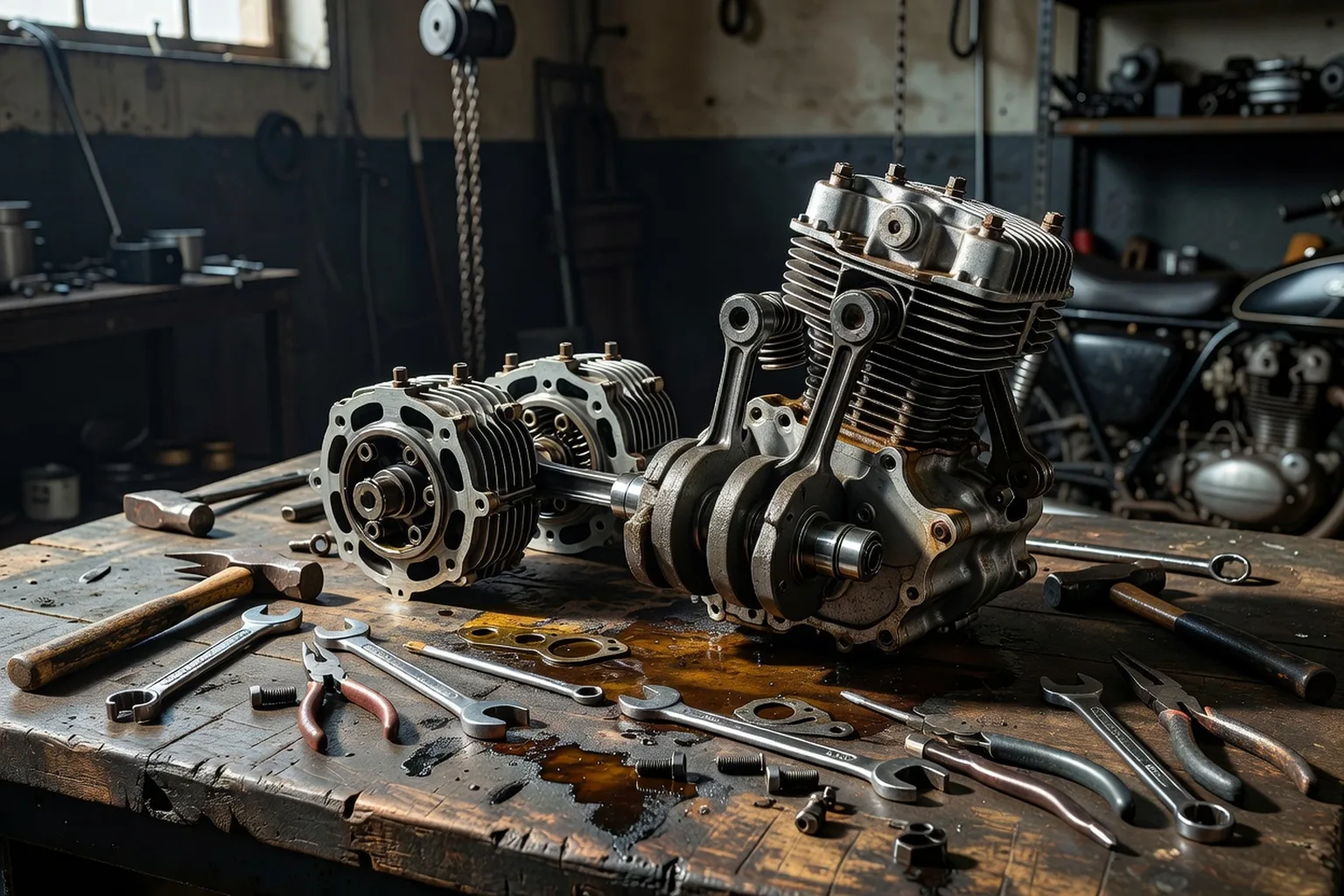
Excessive oil consumption, blue smoke, and dropping compression signal that a Ural's flat-twin needs more than an oil change. This guide walks through diagnosis, the engine-out procedure, reboring, bearing tolerances, and the real cost of a full rebuild.
When Maintenance Stops Being Enough
Regular oil changes and valve adjustments keep a Ural flat-twin running for well over 100,000 km, but every air-cooled engine eventually wears past what preventive maintenance can fix. If you’re topping up oil every few hundred kilometres, seeing blue smoke that lingers past the first minute of running, or watching compression numbers drop on both cylinders, you’re looking at ring and bore wear rather than a leaking gasket. This guide covers what a genuine rebuild involves: diagnosis, pulling the engine, the machining decisions, bearing tolerances, and a realistic budget for doing it yourself versus handing it to a specialist. Routine servicing — oil, filters, valve clearances — is covered separately in our maintenance guide; this article picks up where that one stops.
Key takeaway: Blue smoke that clears within 60 seconds of a cold start, combined with a compression reading under 100 psi on both cylinders that doesn’t rise after a wet test, is the clearest signal that you’re dealing with worn rings and glazed bores — not a top-end gasket problem.
For a broader look at how the platform compares to the German engine it’s descended from, see our Ural vs BMW sidecar comparison.
The Flat-Twin Architecture, and Why It Isn’t a BMW Boxer
The Ural engine is an air-cooled, overhead-valve (OHV) flat-twin, not an overhead-cam boxer like the BMW engines it’s visually compared to. The OHV layout uses pushrods actuating rocker arms from a single camshaft mounted low in the crankcase, a design that traces directly back to the BMW R71 that IMZ originally licensed before the war. This matters practically for a rebuild in three ways:
- Simpler valvetrain: pushrods and rockers are easier to inspect, adjust, and replace than an overhead-cam chain or belt system, and parts are cheaper.
- Lower redline, higher torque focus: the OHV architecture isn’t built to rev, so cylinder and piston tolerances are looser than a high-revving engine, which is part of why the platform tolerates DIY rebuilds reasonably well.
- Shared bottom end across decades: the crankcase, crankshaft, and con-rod architecture has changed relatively little since the Soviet era, so a 1990s and a 2010s carbureted Ural share recognizably the same mechanical logic, even where displacement details differ.
Where the Ural engine departs from a BMW boxer most sharply is machining tolerances: Ural blocks have historically been built looser than German engineering, which is precisely why rebuilds are more common on this platform and why a rebuilder needs to measure rather than assume.
Diagnosing the Need for a Rebuild
Three symptoms, taken together, point toward a rebuild rather than a smaller repair:
- Oil consumption: track it over at least 500 km. Consumption above roughly 0.3-0.5 L per 1,000 km, with no visible external leak at the pushrod tubes, crankcase seams, or valve covers, points to oil being burned past worn rings rather than dripping out.
- Compression loss: a compression test (engine warm, throttle wide open, all plugs out) should read close to even across both cylinders — typically 110-130 psi on a healthy Ural flat-twin depending on compression ratio. A reading below 100 psi, or more than a 15% difference between cylinders, is a red flag. A wet test (a teaspoon of oil in the cylinder, retested) that brings compression back up confirms ring wear specifically.
- Blue smoke on start-up: white smoke is usually condensation and clears in seconds; grey-blue smoke that lingers, especially on deceleration or after idling, is burnt oil — again pointing at rings or valve guide seals.
Key takeaway: Run all three checks before committing to a rebuild. An engine that fails the compression test but shows no oil consumption may only need a top-end valve job; one that fails all three almost certainly needs the bottom end apart.
Pulling the Engine: Procedure and Precautions
The Ural’s frame was designed for field maintenance, and the engine-gearbox unit comes out as a single assembly through the bottom of the frame cradle, without needing to remove the sidecar or split the frame.
Tools required beyond a standard kit: a torque wrench covering the crankcase bolt range (typically 18-25 Nm, verify for your year), an engine hoist or two people to lower the unit safely, drain pans for both engine and gearbox oil, and new crankcase gaskets ordered before you start — never reuse them.
Key precautions:
- Disconnect the battery first and label every electrical connector — EFI models in particular have several connectors that look interchangeable but aren’t.
- Support the frame securely on axle stands before removing engine mounting bolts; the frame will shift once the engine’s weight is gone.
- Drain both engine and gearbox oil before tilting the assembly, and note the gearbox is a separate oil circuit from the engine on most Ural generations.
- Photograph cable and hose routing before disconnecting anything — cold-weather starting behaviour and throttle feel both depend on correct cable routing on reassembly.
- Lower the unit straight down rather than levering it sideways; the mounting points are close-tolerance and easy to bend under lateral force.
Cylinder and Ring Wear: What to Expect
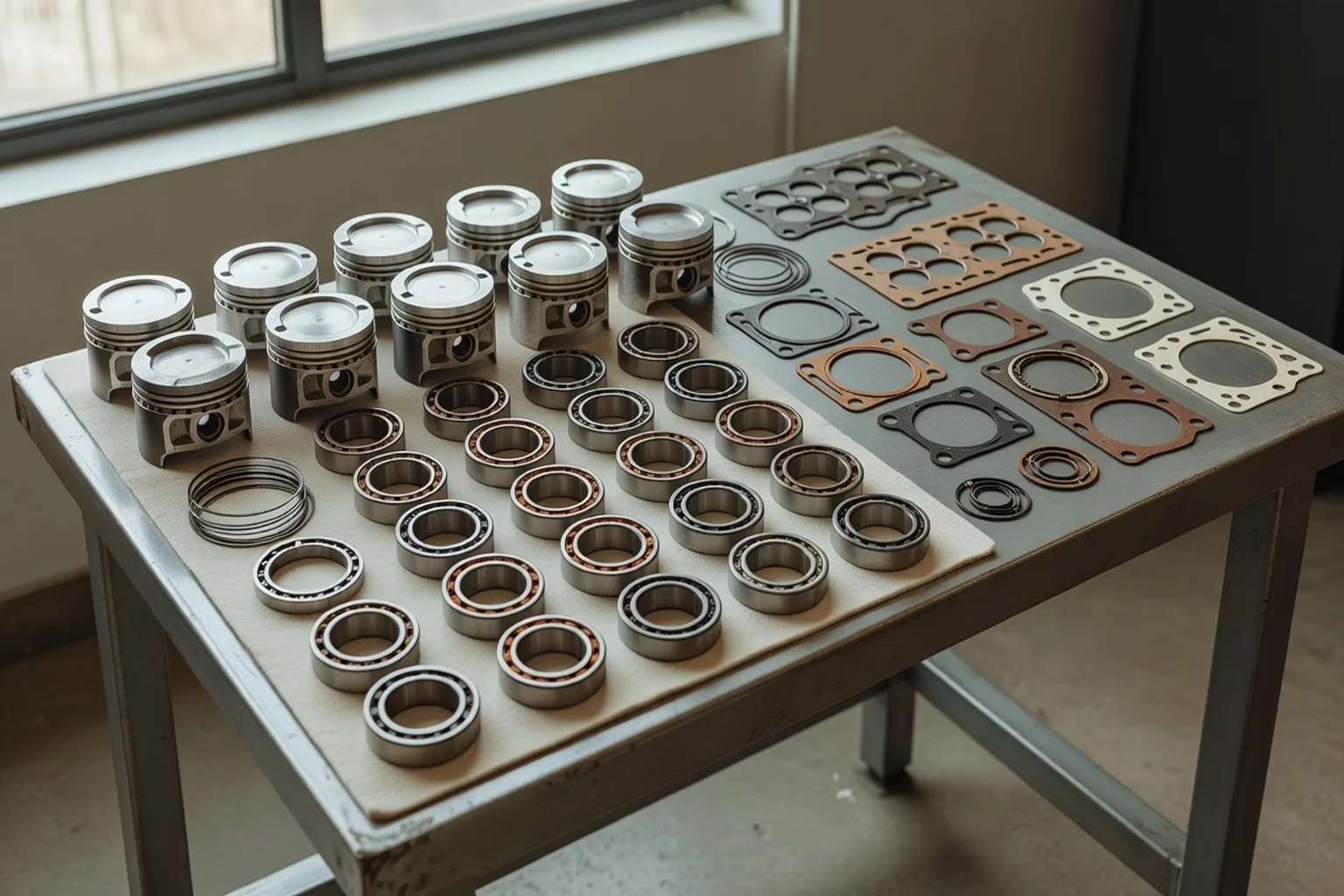
Ural cylinders are typically cast iron, and wear patterns are predictable: an oval taper at the top of the bore where the top ring reverses direction, and a step at the bottom of ring travel. Measuring bore diameter at three heights and two axes reveals whether the taper exceeds the roughly 0.05-0.08 mm wear limit typically cited for this engine family — beyond that, honing alone won’t restore a proper seal.
| Wear condition | Bore measurement | Recommended fix |
|---|---|---|
| Light glazing, no measurable taper | Within 0.02 mm across the bore | Deglaze and hone, fit new rings |
| Moderate taper | 0.03-0.08 mm taper | Bore to first oversize (+0.25 mm or +0.5 mm depending on parts availability), fit oversize pistons and rings |
| Heavy wear or scoring | Beyond 0.08 mm, visible scoring | Bore to next available oversize or replace cylinders outright if oversize pistons aren’t available for your generation |
Oversize pistons are commonly available in +0.25 mm and +0.5 mm increments through the Ural parts network; check availability for your generation before committing to a bore size, since older displacements aren’t always interchangeable with post-2000 parts.
Crankshaft and Bearing Tolerances
The crankshaft assembly (built up from forged halves with pressed-in crankpins on most Ural generations) rides on roller or plain bearings depending on year and application. Two measurements matter most during a rebuild:
- Big-end radial clearance: measured with plastigauge or a dial indicator, should typically fall within the tolerance specified in your model’s manual — as a rule of thumb, clearance noticeably beyond factory spec produces a knocking sound under load and needs bearing replacement, not just cleaning.
- Crankshaft end float: excessive axial play (checked with a dial indicator against the crank nose) indicates worn thrust washers or bearings and, left unaddressed, accelerates wear on the con-rods. If you’re still deciding whether your machine is even worth a full rebuild, our buying used Ural guide covers the mechanical red flags worth weighing against restoration cost.
Key takeaway: Never reuse crankshaft bearings on a rebuild that’s gone this far. The labour cost of a second teardown if a marginal bearing fails within a year far exceeds the price of new bearings the first time.
Generational Parts Differences
Ural production spans carbureted engines through the 2000s and early 2010s and EFI (electronic fuel injection) from roughly the mid-2010s onward for most export markets. For a rebuild, the practical differences are:
- Bottom end: largely interchangeable in principle across generations of the same displacement family, but always cross-reference part numbers rather than assuming — casting revisions exist.
- Top end: carbureted heads and EFI throttle-body heads are not interchangeable without also swapping the associated wiring and fuel delivery components.
- Ignition: older engines may still be on points-and-condenser or early electronic ignition; later carbureted and all EFI models use fully electronic ignition, which is not something to convert mid-rebuild unless you’re planning that upgrade deliberately.
DIY vs Specialist: A Decision Grid
| Factor | Lean DIY | Lean specialist |
|---|---|---|
| Tools available | Torque wrench, hoist/engine stand, precision measuring tools on hand | Missing bore gauge, plastigauge, or a way to safely support/lift the engine |
| Machining needed | None (rings/hone only) | Boring required — always send to a machine shop regardless of who does the rest |
| Time budget | Can dedicate several weekends without needing the bike | Bike needs to be back on the road within weeks |
| Experience level | Comfortable reading tolerances and following torque sequences | First engine teardown of any kind |
| Access to specialists | None within reasonable shipping/travel distance | Established Ural specialist network in Europe or North America available |
A large share of Ural owners split the difference: teardown and reassembly at home, cylinders shipped to a machine shop for boring and honing, and crankshaft clearances double-checked by a specialist before final assembly. This keeps specialist labour costs to the parts of the job that genuinely require precision machinery.
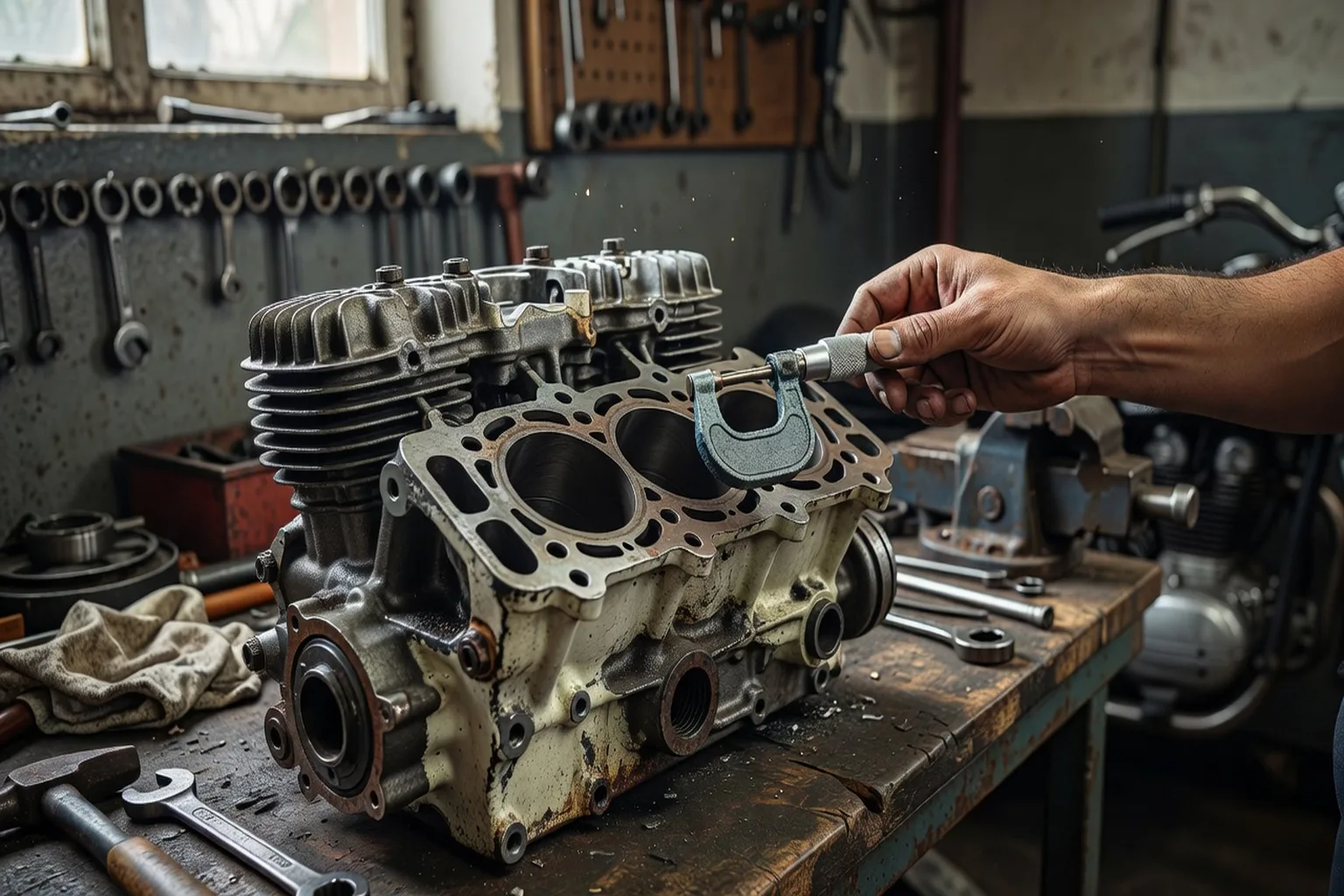
For sourcing gaskets, bearings, and oversize pistons, see our Ural spare parts guide, and for a broader view of what a rebuild does to long-term ownership costs, our total cost of ownership analysis puts occasional major work into context against routine running costs.
Reassembly Sequence and Break-In
Install the crankshaft assembly first, checking end float and big-end clearance one final time before closing the crankcase halves. Torque crankcase bolts in stages — roughly a third, two-thirds, then full torque — rather than tightening each fastener fully in one pass. Fit pistons with rings correctly gapped and staggered, using a ring compressor to avoid cracking new rings against the cylinder base. Set valve clearances only after the top end is fully torqued down, since clearances shift slightly as fasteners seat, and prime the oil system before the first start by turning the engine over on the starter with the plugs out until oil pressure registers.
Break-in after a rebuild follows different rules from a factory-new engine: avoid extended idling, avoid sustained high loads for the first 500-800 km, and vary engine speed rather than holding a constant RPM. Change the oil and filter after this break-in period specifically, since new rings shed measurable metal into the oil while seating.
Key takeaway: A rebuild that skips a proper break-in period risks glazing the new bores prematurely — the same failure mode you just spent a weekend fixing. Treat the first 500-800 km as part of the rebuild, not as ordinary riding.
Common Rebuild Mistakes to Avoid
- Reusing old gaskets to save a modest cost: a leak discovered after reassembly means pulling the engine again.
- Skipping the wet compression test during diagnosis: without it, valve wear is easily misdiagnosed as ring wear, leading to unnecessary boring.
- Over-torquing crankcase fasteners: Ural crankcases are not immune to cracking or thread damage; work to the specified figures, not “as tight as it’ll go.”
- Ignoring gearbox oil during an engine-out job: since the gearbox typically comes out with the engine, it’s easy to neglect checking its oil while everything is already apart.
- Not documenting cable routing before disassembly: a swapped or pinched cable can cause cold-start or throttle issues that are hard to diagnose once everything is bolted back together.
Frequently Asked Questions
A rebuild is warranted when a compression test on both cylinders reads below roughly 100 psi (cold) with no improvement after a wet test, when oil consumption exceeds about half a litre per 1,000 km with no external leaks, and when you can see continuous blue smoke on start-up that clears within a minute — pointing to worn rings and glazed bores rather than a single gasket or valve issue.
Yes. The Ural flat-twin and gearbox come out through the bottom of the frame on jack stands, without a motorcycle lift, because the frame's open cradle design was engineered around field service. You do need a solid engine stand or a sturdy bench, a torque wrench rated for the crankcase bolt sequence, and a way to safely support the frame while the powertrain is out — most owners use axle stands under the frame rails.
Mechanically, the bottom end (crankshaft, con-rods, cylinders, pistons) is essentially the same architecture across carbureted and EFI generations. The difference is on top: EFI models (2015 onward for most markets) add throttle bodies, injectors, an ECU, and a crank position sensor, none of which need to be disturbed for a bottom-end rebuild. Where it matters is reassembly — EFI models require the ECU to relearn idle and fueling after any internal work, so plan a proper break-in and a dealer or specialist reflash if fault codes appear.
For a DIY rebuild using genuine or OEM-equivalent gaskets, rings, and bearings, expect roughly €800-1,400 in parts depending on whether the cylinders need boring to the first oversize. Adding professional machining (boring and honing) typically adds €150-300 per cylinder. A full rebuild done by a specialist shop, including labour, commonly lands between €2,500 and €4,000, depending on the country and whether the cylinders are replaced rather than bored.
It depends on the rest of the machine's condition and your intentions. A rebuild restores the engine to a like-new state and, on a bike with a sound frame, sidecar, and electrics, is usually more cost-effective than buying a comparable used EFI model — especially since parts commonality across Ural generations keeps rebuild costs predictable. If the frame, wiring, or sidecar chassis also need significant work, the calculation shifts toward replacement.